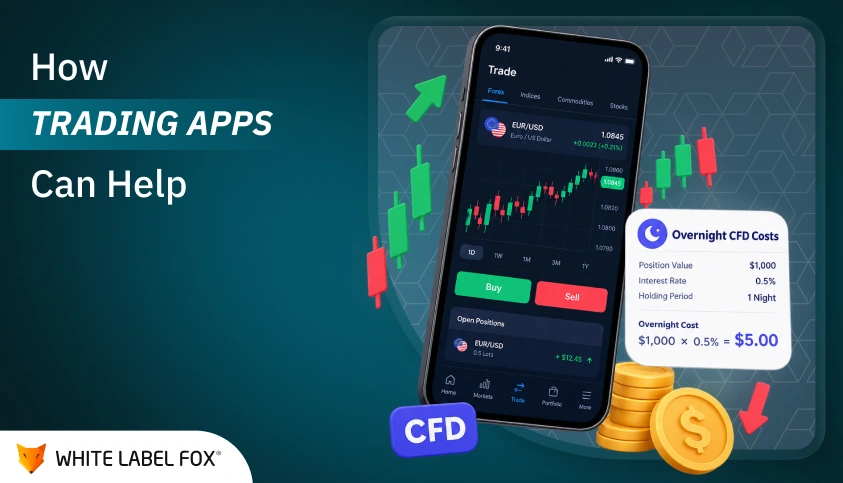
A CFD trade can become more expensive even when its market price barely moves. Hold a position past the provider’s daily cutoff, and an overnight financing charge or credit may affect your account.
Trading apps can make those adjustments easier to understand by showing the rate, calculation, and timing alongside your position. Clear information cannot remove the risks of leveraged trading, but it can help you understand what keeping a trade open might cost.
Making Overnight CFD Costs Visible Before Trading
A useful trading app puts financing details near the order screen, rather than leaving them buried in a separate document. Before opening a position, you should be able to check whether overnight financing applies and where to find the relevant terms.
According to a review by the Financial Conduct Authority, some CFD providers need clearer explanations of overnight funding calculations. For you, better disclosure means fewer gaps between the advertised trading conditions and the costs you actually encounter.
An app can show an estimated daily amount alongside the rate. Labeling that figure as an estimate helps distinguish a planning tool from a guaranteed charge.
Understanding Published Financing Rates
A trading app should help you understand a financing rate, not simply display a number. Clear labels and brief explanations can show which figure applies to your CFD position and what it means for your account.
Overnight CFD financing charges may be labeled as swaps. They’re charged or credited based on the position you hold. A good trading app will publish swap rates.
You’ll then know exactly what you’ll pay or earn. And holding positions overnight will always be clear and predictable.
A useful display should clarify three details:
- Which rate applies to your position
- What units the rate is quoted in
- Whether it represents a charge or credit
With those details visible, you have a clearer basis for interpreting the published rate. The next step is understanding how it translates into an estimated cost for your trade.
Turning Rates Into Dollar Estimates
Trading apps can translate financing terms into an account-currency estimate. A calculator becomes more useful when it shows its assumptions instead of presenting an unexplained total.
Showing the Relevant Position Size
The calculation should make clear whether financing uses the full position exposure rather than just the margin deposited. Confusing those amounts can make an overnight charge look unexpectedly high.
For example, a hypothetical $10,000 position supported by $500 in margin still represents $10,000 of market exposure. Seeing both figures together helps explain why the deposit alone is not a reliable guide to financing costs.
Showing the Estimated Holding Period
Suppose an illustrative position costs $2 per day to finance. Five chargeable days would total $10 if the daily amount stayed unchanged.
An app should identify that assumption clearly. Rates, position size, and the provider’s charging schedule can change the final amount.
Explaining Cutoffs and Charging Schedules
“Overnight” needs a precise definition on the trading screen. An app can display the provider’s rollover time and identify the time zone used, helping users understand when an open position becomes subject to financing.
Calendar information can explain any multiple-day adjustments described in the provider’s terms. Rather than asking you to infer the schedule, the app can show which upcoming rollover carries which charge.
A reminder before the cutoff can prompt you to review the position and its estimated cost. Such a reminder should provide information, not imply that closing immediately is automatically the right decision.
Separating Financing From Other Trading Costs
Financing is easier to understand when it appears separately from spreads, commissions, and other account charges. A single total can hide which expense came from entering the trade and which came from keeping it open.
An app can present a cost breakdown for the selected position and holding period. Where estimates are available, keeping the assumptions consistent makes comparisons more meaningful without pretending that every trading cost is fixed.
Connecting Estimates With Account History
Understanding improves when you can compare a preview with the amount eventually posted. An app can show financing entries beside the relevant position, including the date, amount, and whether the adjustment was a debit or credit.
A useful history view also lets you total financing over the life of a trade. Several small daily charges may be easier to evaluate as one cumulative figure.
If the actual amount differs from an earlier estimate, accessible calculation details can help explain the difference. Position changes, updated rates, or charging schedules are worth checking before assuming an error occurred.
Make Overnight Holding Decisions With Clearer Costs
The most useful apps make overnight CFD costs visible before a trade and traceable afterward. Rate labels, estimates, rollover schedules, and account records help you understand the expense without confusing transparency with protection from trading losses.
Before your next overnight hold, review those details alongside the position’s risks. And if you’ve found this article to be useful, explore some of our related posts.

Deep Faldu - CTO
Author
As the Chief Technology Officer, Deep Faldu spearheads innovation at White Label Fox, ensuring seamless, scalable, and high-performance app solutions. His technical expertise, problem-solving skills, and commitment to excellence help businesses thrive in the competitive digital landscape. He continuously explores new technologies to enhance product efficiency and user experience.