Buying a chatbot for a ten-person company and buying one for a bank are different projects wearing the same name. The bank needs audit trails, data residency, a plan for model failures, and an answer to who approved a given response. The small shop needs something live by Friday.
This list is for the bank end of that spectrum: platforms large organizations put through procurement, security review and years of integration. For the risk conversation, NIST's AI Risk Management Framework is a handy checklist for questions to put to any vendor below.
What makes a chatbot "enterprise"?
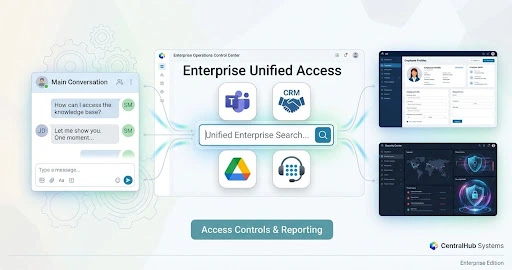
Scale, security and integration. An enterprise bot serves thousands of users, connects to core systems, and has to pass reviews from IT, legal and compliance.
It also needs admin controls, logging and a support team that picks up the phone.
Why enterprises are investing
Contact centers face rising volumes and staffing pressure. Employees lose time on repetitive HR, IT and finance questions.
A well-run bot handles the routine ones around the clock and frees people for work that needs judgment.
What to look for
- Security and compliance: Certifications, data residency and audit logs.
- Integration depth: Real connections to your CRM, ERP and contact center.
- Deployment options: Cloud, multi-cloud or on-premises.
- Testing tools: Simulations and evaluations before changes go live.
- Total cost: Year two and three, not just the pilot.
Build an AI Chatbot That Moves Your Business Forward
Create a scalable enterprise chatbot with the right features, integrations, and automation capabilities to support your evolving business needs.
Quick comparison
| Company | Best for |
|---|---|
| Glean | Employee assistants that answer from company knowledge |
| IBM watsonx Orchestrate | Hybrid and on-premises control |
| Google Cloud CX Agent Studio | Google Cloud shops that want built-in testing |
| Amazon Lex | AWS teams that want pay-as-you-go building blocks |
| Yellow.ai | Multilingual, multi-channel customer service |
| NICE Cognigy | Contact center automation |
| LivePerson | Messaging-centered service |
1. Glean
Most enterprise chatbot projects fail quietly: the bot can't find the right information, or finds it and shows it to the wrong person. The enterprise AI platform by Glean is designed around that problem.
It indexes content across more than 250 connected apps and applies each user's existing permissions at query time. Teams can extend it through APIs.
Best for: assistants that help employees get accurate answers from everything the company owns. It's less of a fit for a voice bot answering inbound calls.
2. IBM watsonx Orchestrate
IBM's pitch is orchestration and control. It helps teams discover, build and manage agents, with tooling for evaluation, governance and cost tracking.
It can run across multiple clouds or on-premises.
Best for: regulated companies that already work with IBM and need hybrid infrastructure.
3. Google Cloud CX Agent Studio
Google's studio is Gemini-powered, with a low-code builder, a conversation simulator and evaluations that catch regressions before production. It offers prebuilt templates and strong voice support.
Best for: companies whose data and apps already live on Google Cloud.
4. Amazon Lex
Lex is the building-block option for voice and text bots. It integrates natively with Amazon Connect, AWS's contact center, and bills per request.
You assemble more of the experience yourself.
Best for: AWS teams that want flexible, usage-based economics.
5. Yellow.ai
Yellow.ai runs on many language models, avoiding lock-in, with an agent builder, analytics and voice support in a large number of languages. It lists a long set of prebuilt integrations.
Best for: multilingual customer service across several channels.
6. NICE Cognigy
Cognigy has deep roots in contact center automation, and NICE completed its acquisition in September 2025. That pairs a conversational AI builder with a major contact center vendor.
If you don't already use NICE, ask how it works with your other systems.
Best for: contact centers looking to automate voice and chat.
7. LivePerson
LivePerson built its reputation on messaging. Its Conversational Cloud detects intent and runs personalized conversations, with tools to build, test and monitor AI agents.
Best for: enterprises that want messaging at the center of their service model.
Security questions to ask
Where is data stored, and for how long? Is customer data used to train models? Who can see conversation logs? What happens if a model provider changes or goes down?
Get the answers in writing, and map them to your own risk framework.
What enterprise buyers often overlook
Change management. The best platform still fails if support teams, legal and IT don't agree who owns the bot after launch.
Name an owner, a review cadence and an escalation path before go-live. It costs nothing and saves months.
Voice vs. text
Voice bots are harder than chatbots. They deal with accents, interruptions and noisy lines, and latency is far more noticeable.
If voice is part of your plan, ask each vendor for live voice demos and not just text transcripts.
Build, buy or hire help
Large companies rarely do everything alone. Some buy a platform, some build on cloud services, and many bring in outside developers.
Agencies offering AI development services, covering strategy, custom models and integration, can fill capacity gaps. Make sure the contract keeps ownership of your data and prompts with you.
How pricing usually works
Cloud platforms like Google and Amazon bill by usage, per session or per request. Suite and platform vendors often sell licenses or credits. Agencies charge per project or per month.
Usage-based pricing is cheap at pilot scale and harder to predict at full volume, so model a busy month before you sign.
What a rollout looks like
Expect a discovery phase, a proof of concept, a limited launch and then a gradual expansion. Security review and integration work take the longest.
Keep a small cross-team group meeting weekly. Issues surface faster, and decisions don't stall.
Common mistakes
Choosing on the demo is the usual one. Another is underestimating integration work, which often takes longer than building the bot itself.
A third is launching everywhere at once. Start with one use case, prove it, then expand.
How to run the evaluation
Insist on three things. First, a proof of concept on your own data and the hardest questions, not the vendor's sample content.
Second, a written explanation of how each vendor handles permissions, logging and model changes, ideally mapped to a framework like NIST's. Third, a clear cost model for the second year.
The short version: Glean for knowledge-driven assistants, IBM and the two cloud platforms for build-it-yourself control, and Yellow.ai, NICE Cognigy or LivePerson when the contact center is the center of gravity.

Viral Kacha - CEO & Sales Head
Author
With years of expertise in the on-demand app industry, Viral Kacha leads White Label Fox with a vision to empower startups and enterprises with top-tier, ready-made app solutions. His strategic approach, strong leadership, and deep market understanding drive business growth, innovation, and client success. He is dedicated to helping businesses scale efficiently with cutting-edge technology.