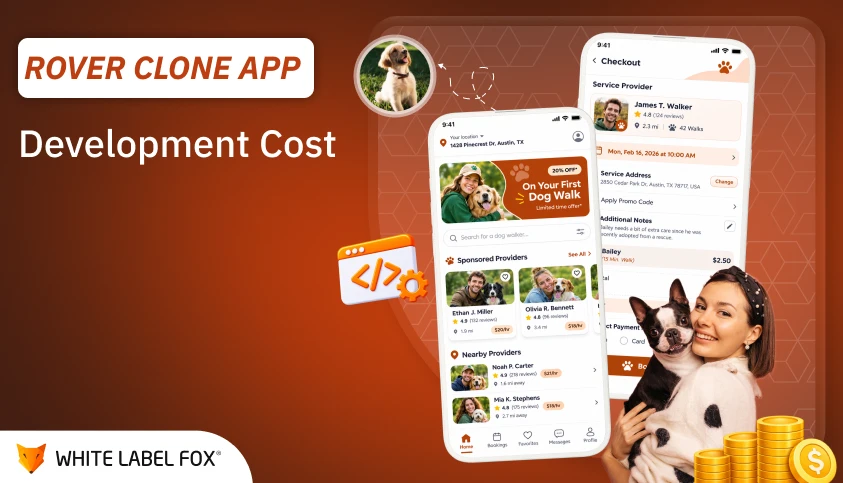
Pet owners now book walks, sitting and boarding the same way they book a cab: on an app. Rover made that habit mainstream, and founders entering the market ask the same first question: how much does Rover clone app development cost?
The honest answer is that it depends on how you build it. A ready-made script costs far less and launches much faster than a custom build, while published estimates for custom builds alone run from about $15,000 to well over $200,000. This guide explains why prices differ so much, what you actually pay for, and how to pick the right route for your pet care business.
Rover clone app development cost depends on the build approach. Market estimates for custom-built Rover-like apps range from about $15,000 to $200,000+, with timelines of 4 to 10 months. A ready-made, white-label Rover clone script costs less and can go live in days. Your final Rover clone app price depends on features, platforms, branding and integrations.
Ready to Launch Your Own Rover Clone App?
Get a clear price for your pet care business. Our team will match the right features to your market and budget, and you can go live in as little as 5 days with 100% source code ownership.
Why a Rover-Style App Is Worth Building Now
The pet care market keeps growing. Fortune Business Insights values the global pet sitting market at USD 3.06 billion in 2025 and expects it to reach USD 8.47 billion by 2034, a growth rate of about 12% a year. In the United States, IBISWorld counts 59,279 dog walking businesses, and that number has grown about 6.3% a year between 2021 and 2026.
Rover is the best-known name in this space. It connects pet owners with trusted sitters and walkers for dog walking, boarding, house sitting and day-care, and it earns by taking a share of each booking.
A Rover clone app copies that marketplace model: you run the platform, local pet sitters and walkers list their services, and pet owners book and pay inside the app. If you want the full revenue picture first, read our guide to the Rover business model.
This model also suits a multi-service pet care business. You can launch with dog walking and add house sitting, doggy day-care or boarding as your provider base grows.
Rover Clone App Cost at a Glance: Three Ways to Build
Before looking at features, decide how you want to build. This single choice changes your budget more than any other.
| Approach | Typical cost | Launch time | Code ownership | Best for |
|---|---|---|---|---|
| Ready-made Rover clone script (white-label) | Lowest upfront cost; quote-based | Days to a few weeks | Depends on the vendor | Startups testing a local market |
| Customised white-label Rover clone | Mid-range; depends on the changes you request | Faster than a custom build | Depends on the vendor | Brands that need their own flows and look |
| Custom build from scratch | Published estimates of about $15,000 to $200,000+ | 4 to 10 months | Full ownership | Unique features and large budgets |
A ready-made Rover clone script gives you the core platform: pet owner app, walker or sitter app, and admin panel. You add your logo, colours and local payment methods, and you can launch quickly. A custom build starts from a blank page, so you pay for every screen, API and test cycle.
For most first-time founders, the script route lowers risk because you can test demand before investing heavily.
Why Rover Clone App Quotes Range from $15,000 to $200,000
If you have searched for the cost of an app like Rover, you have seen wildly different numbers. Here is what several agencies publish for custom-built Rover-like apps:
| Source | Published range | What it covers |
|---|---|---|
| Auxano Global Services | $15,000 to $45,000 | iOS, Android and a web admin panel with core booking features |
| Miracuves | $30,000 to $50,000+ | A full-featured build with scheduling, chat, CRM and analytics |
| Depex Technologies | $40,000 to $200,000 | A range from basic MVP to a scalable, full-featured platform |
| Techugo | $80,000 to $180,000+ | US-market estimate that rises with design, security and team location |
These figures are not wrong, they simply describe different projects. A basic MVP built by an offshore team sits at the bottom, while a polished, heavily customised platform built by a US team sits at the top. Always ask what a quote includes: platforms, design depth, admin panel, testing, source code and post-launch support.
What You Are Paying For: Three Apps in One Platform
A Rover-style marketplace is really three products working together. Every feature you add increases design, development and testing effort.
1. Pet owner app
- Sign-up, login and pet profiles with details such as breed, age and care notes
- Search for sitters and walkers, view profiles, ratings and prices
- Booking and scheduling for walks, boarding, house sitting or day-care
- Secure in-app payments and booking history
- Live GPS tracking during walks, photo updates and push notifications
- In-app chat, reviews and ratings
2. Pet sitter and dog walker app
- Profile creation with services, rates, portfolio and service area
- Calendar and availability management
- Booking requests to accept or decline, plus walk start and end controls
- Wallet, earnings reports and payout tracking
3. Admin panel
- User and provider management, including identity and background verification
- Commission, promo code and offer management
- Booking oversight, support requests and dispute handling
- Revenue reports, invoices, and content pages such as FAQs and policies
Many vendors also offer extras: a mobile wallet, revenue analytics, review prompts, weather updates and verified-provider badges. These add cost but can improve trust and repeat bookings.
Rover Clone App Cost by Feature
Exact prices vary by vendor, so this table shows relative effort. It helps you see where your budget goes and what to simplify first.
| Feature | Effort | Why it costs what it does |
|---|---|---|
| Registration and profiles | Low | Standard flows, but three user roles need separate logic |
| Search and provider listings | Medium | Filters, location logic and ranking add backend work |
| Booking and scheduling | Medium to high | Availability, time slots, cancellations and multi-pet bookings |
| Payments and payouts | High | Split payments, commission, refunds and provider payouts |
| Live GPS tracking | High | Real-time location, map APIs and battery-safe background tracking |
| In-app chat | Medium | Real-time messaging, notifications and moderation tools |
| Reviews and ratings | Low | Simple to build, important for trust |
| Background checks and verification | Medium to high | Third-party integrations and document review workflow |
| Admin panel and reports | Medium to high | Dashboards, commission controls and data exports |
7 Factors That Change Your Pet Sitting App Development Cost
1. Feature scope. A lean MVP with booking, payments and chat costs far less than a platform with analytics, wallets and loyalty programs.
2. Platform choice. iOS, Android or both. Native apps for both platforms need separate codebases, which usually costs more than a cross-platform build.
3. Design and UI/UX. Custom animations and brand-specific design take more designer hours than a clean, template-based interface.
4. Technology stack. Real-time tracking, AI-based matching and scalable cloud infrastructure raise the build effort.
5. Team location. Hourly rates differ widely between the US, Europe and Asia, which is a major reason quotes vary.
6. Third-party integrations. Payment gateways, map APIs, SMS, chat services and background-check providers each add setup work and running fees.
7. Trust and safety needs. Verification, insurance workflows, and dispute tools matter in pet care because owners hand over a family member.
Behind the scenes, a typical project team includes a project manager, business analyst, UI/UX designer, mobile developers and a QA engineer. A custom build pays for all of them for months. A ready-made script shares that work across many clients, which is why it costs less.
Hidden and Ongoing Costs to Plan For
The build price is only part of your budget. Plan for these recurring items from day one:
- Hosting and servers: monthly cloud costs that grow with users and tracking data.
- Maps and GPS: map and location APIs are usually billed by usage.
- Payment processing: Stripe's marketplace product, Stripe Connect, charges your platform $2 per monthly active account plus 0.25% and 25 cents per payout when you set your own pricing. If you let Stripe handle pricing for your users, there is no platform fee. Always check current Stripe Connect rates for your country.
- Background checks: providers usually bill per check, so budget for every new walker or sitter you onboard.
- Push notifications and SMS: small per-message fees that add up with active users.
- App store accounts: yearly developer fees for Apple and Google.
- Maintenance and updates: bug fixes, security patches and updates for new iOS and Android versions.
- Marketing and provider acquisition: a marketplace needs sitters and owners on both sides, so budget for local campaigns.
How Long Does It Take to Build an App Like Rover?
For a custom build, Depex Technologies estimates 4 to 6 months for an MVP and 8 to 10 months for a full-scale version. That time covers planning, design, development, testing and store approval.
A ready-made Rover clone app skips most of that work because the core modules already exist and are tested. At White Label Fox, you can launch in as little as 5 days after branding and setup, which lets you start onboarding pet sitters while a custom competitor is still in design.
Rover Clone vs Custom Development: How to Decide
Choose a Rover clone script if you:
- want to launch quickly and test your local pet care market
- have a limited budget and want predictable pricing
- need proven features such as booking, GPS tracking, chat and payments
- plan to grow into a multi-service pet care business over time
Choose custom development if you:
- have a truly unique concept that existing platforms cannot support
- need deep integrations with your own systems
- have a large budget and can wait many months for launch
Many founders start with a white-label Rover clone app and customize it as revenue grows. You keep the speed advantage today and the freedom to extend tomorrow, especially when the vendor gives you full source code.
How a Rover-Style App Earns Back Its Cost
Rover's own help center shows the benchmark. In the US, owners pay an 11% booking fee at checkout, and providers pay a 20% service fee on each booking, so they take home 80%. Fees vary by country, but the idea is clear: a marketplace earns on every completed booking.
Your Rover clone can use one or more of these revenue streams:
- Commission per booking taken from the provider's earnings.
- Customer booking fee added at checkout.
- Provider subscriptions for lower commission or higher visibility.
- Featured listings for sitters who want to appear first in search.
- Add-on services such as extra walks, medication visits or premium day-care packages.
To estimate payback, divide your total launch budget by your expected monthly commission. A cheaper launch cost means you reach break-even with far fewer bookings, which is another reason many founders begin with a ready-made script.
How to Reduce Cost Without Cutting Quality
- Start with one city and one or two services, such as dog walking and house sitting.
- Launch an MVP with booking, payments, chat and reviews, then add extras after real user feedback.
- Use a cross-platform approach or a ready-made script instead of two separate native builds.
- Never cut trust features. Verification and secure payments protect your reputation.
- Ask your vendor for a phased roadmap so you pay for new modules only when you need them.
How to Choose a Rover Clone App Development Company
The right partner matters as much as the price. Before you sign, check these points:
- Source code ownership: confirm in writing that you receive the full code.
- Live demo: test the owner app, provider app and admin panel yourself.
- Transparent quote: ask what is included and what costs extra.
- Customisation ability: make sure they can adapt features to your market.
- NDA and security: your business idea and user data must be protected.
- Post-launch support: bug fixes, updates and help when you scale.
Launch Your Pet Care Business with White Label Fox
White Label Fox builds white-label Rover clone apps for entrepreneurs who want to start a multi-service pet care business without long development cycles. You get a ready-made platform for dog walking, house sitting, doggy day-care and pet boarding, branded with your name and your colours.
- Launch in as little as 5 days
- 100% source code ownership
- NDA protection for your business idea
- Owner app, provider app and admin panel included
Ready to see what your Rover clone would cost? Get a free, no-obligation quote and our team will map the right features and budget to your market.
Final Thoughts
Rover clone app development cost is not one fixed number. It depends on whether you choose a ready-made script, a customised white-label app or a full custom build, and on the features, integrations and support you need. For most new pet care businesses, starting with a white-label Rover clone is the fastest and most affordable way to enter the market. The right Rover clone app development company will give you a clear quote, full source code ownership and support after launch.
Want a clear price for your idea? Talk to White Label Fox, a trusted clone app development company, and launch your pet care service app with confidence.
Frequently Asked Questions

Deep Faldu - CTO
Author
As the Chief Technology Officer, Deep Faldu spearheads innovation at White Label Fox, ensuring seamless, scalable, and high-performance app solutions. His technical expertise, problem-solving skills, and commitment to excellence help businesses thrive in the competitive digital landscape. He continuously explores new technologies to enhance product efficiency and user experience.