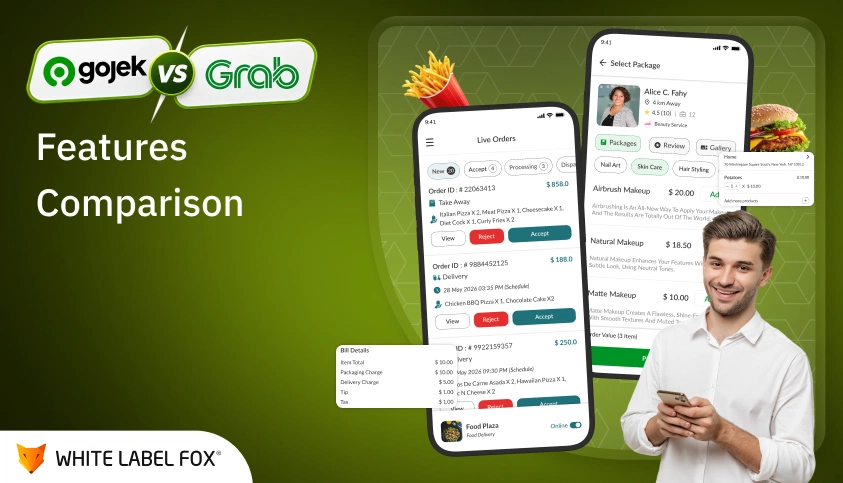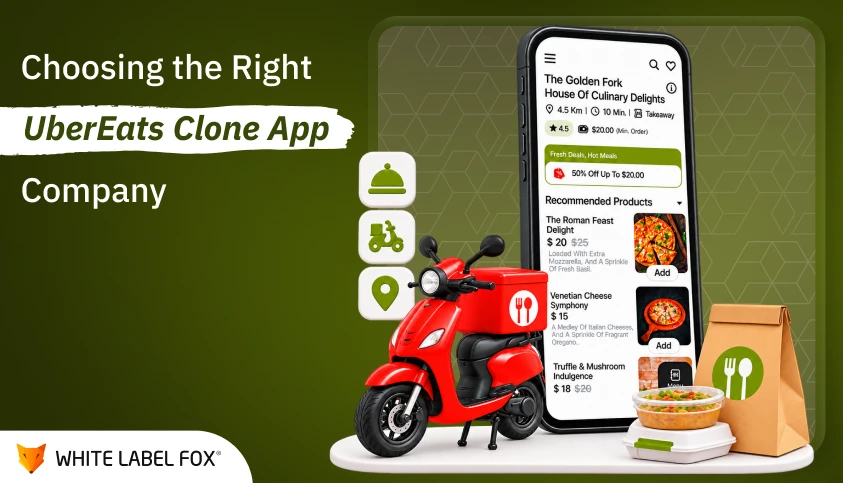
Choosing an UberEats clone app development company decides whether your food delivery launch runs smoothly or stalls on hidden costs, locked code and missing support. The app itself is only half the purchase. The other half is the team, the licence and the contract behind it.
Look for a team that hands over the full source code, ships every app and panel in the package, lets you change business rules, follows payment security standards, shows a live demo and commits to post-launch support in writing. The rest of this guide shows you how to check each point.
If you plan to start an online food delivery business with a food delivery app like UberEats, this guide shows exactly what to verify. It covers a 12-point checklist, questions to ask before you sign, red flags, a scorecard and the contract terms to lock down. Whether you speak to a specialist or a general food delivery app development company, the same checks apply.
Why the Choice of Company Matters More Than the App
Most buyers of food delivery app development services compare vendors on price and a single UberEats clone app demo, then discover the gaps later: a driver app sold as an add-on, source code that stays with the vendor, or support that ends after the first month. Demand makes the problem worse.
Statista's outlook puts worldwide online food delivery revenue at roughly US$1.5 trillion in 2026, although that figure combines meal delivery and grocery delivery. A growing online food delivery market attracts many vendors of very different quality. Two apps can look identical in a demo and still differ completely in ownership, security and long-term cost. That is why the vendor behind a food delivery app like UberEats matters as much as the product.
Building Your Vendor Shortlist?
Put White Label Fox on your shortlist and test us the way this guide suggests. Book a demo, request an itemized quote and ask the same questions you ask every other vendor.
White Label vs Custom Food Delivery App: Decide This First
Before you shortlist anyone, decide which route fits your budget and timeline. A white-label food delivery app is a finished platform that you rebrand and extend. A custom build of an app like UberEats is written from scratch to your specification.
A ready UberEats clone script sits in the first group, and it only makes sense when the vendor lets you modify it. A white-label seller and a custom developer are different kinds of company, so choose the route before you compare vendors.
| Factor | White-label clone | Custom build |
|---|---|---|
| Time to launch | Faster, because the core apps already exist | Slower, because everything is designed and built from zero |
| Upfront cost | Lower | Higher |
| Control over features | Good, if source code is included | Full control |
| Uniqueness | Depends on how much you customize | High |
| Technical risk | Lower, the core is already tested | Higher, you carry more of the build risk |
| Best for | Startups and restaurant groups testing a market | Companies with unusual workflows and larger budgets |
Many buyers choose a middle path: a white-label food delivery app with paid customization on top. If that is your plan, the quality of the base product and the licence terms matter even more.
How to Choose an UberEats Clone App Development Company: The 12-Point Checklist
Use these twelve checks on every vendor you speak to. For each one, ask for proof, not promises.
1. Proven food delivery experience
Food delivery app development is a specialist field, so ask for live apps in the app stores, not screenshots or mockups. A credible UberEats clone app development company will name clients and let you speak to them. Ask what problems they solved after launch, such as peak-hour load, payout errors or driver GPS issues, because those answers show real operating experience.
Review platforms such as Clutch, together with past work, help you cross-check claims. A good sign is a vendor that shows you a live food delivery platform processing real orders; a bad sign is one that only shows a polished demo environment.
2. UberEats clone source code ownership
This is the most expensive point to get wrong. Clarify in writing whether you receive the full source code for every app and the backend, whether the licence is one-time or subscription-based, and whether you can host the platform on your own servers and hire another developer to maintain it.
Some vendors sell an UberEats clone script but keep core modules encrypted or tied to their own servers. Ask for a licence clause that states exactly what you own. If the answer is vague, treat it as a no until you see it in writing, because changing vendors later is very hard without the code.
3. Complete product scope
List every component your online food delivery business expects: iOS and Android customer apps, a restaurant app, a driver app, a restaurant web panel and an admin panel. Then check which of them are in the base price and which are add-ons. A low quote that leaves out the driver app or the admin panel is not really a low quote.
4. UberEats clone app features that fit your model
Core UberEats clone app features should be standard: restaurant search and filters, live order tracking, multiple payment methods, push notifications, promo codes, ratings and reviews, driver payouts and an analytics dashboard.
Then check the features that separate one vendor from another:
- Flexible commission and delivery-fee rules by zone, restaurant or order value
- Scheduled orders and multi-restaurant carts
- Multi-language and multi-currency support
- Manual and automatic dispatch controls
- Refund, dispute and cancellation handling in the admin panel
Do not pay for an UberEats clone script with a long feature list you will never use. Match features to your business model first, then check that each one works in the demo and not only on a feature list.
5. Customization depth
In white-label food delivery app development, branding changes are the easy part. Ask how the vendor handles changes to business logic: a new delivery pricing model, an extra module such as grocery or pharmacy delivery (the multi-category model behind a Glovo clone app), or a local payment method. Ask what is included in the quote, what is billed per hour and who owns the code written during customization.
6. Scalability and architecture
A food delivery app that works for 50 orders a day can fail at 5,000. Ask how the food delivery platform handles traffic spikes, whether it supports multiple cities and vendors, as a large Delivery Hero Clone App needs, and which hosting setup the vendor recommends. Common stacks include React Native or Flutter on the front end and Node.js, Laravel or Django on the back end, with PostgreSQL or MongoDB for data. No single stack suits everyone, so ask why the vendor chose theirs and how it will be maintained.
7. Payments and security
Your online food delivery platform will handle payments and personal data, so security cannot be an afterthought. The PCI DSS requirements that were once treated as best practice have been mandatory since 31 March 2025, so ask directly how the vendor handles card data. Most clone apps send card details to a hosted payment gateway instead of storing them, which reduces your exposure.
Also confirm multi-factor authentication for admin accounts, encrypted data storage and privacy compliance such as GDPR if you serve users in Europe. A vendor that can explain its security setup in plain language and share documentation is a better bet than one that only says the app is secure.
8. Integrations
Check which payment gateways, map providers, SMS and OTP services, push notification tools and POS systems already work out of the box. Ask for API documentation. If the vendor cannot show it, future integrations will be slow and expensive. Local payment methods and SMS providers matter most here, because they differ from country to country.
9. Real AI and automation
Many vendors advertise AI features in their food delivery app. Ask what they actually do: automatic driver assignment, route optimization, demand-based pricing or personalized restaurant recommendations. Then ask to see each one working. A feature you cannot see in action is only a sales line.
10. Transparent pricing
Ask for an itemized food delivery app development quote that covers the licence, customization, hosting, app store publishing, third-party fees for maps, SMS and payments, and annual updates. Hidden recurring costs are the most common reason a budget is blown after launch. Ask the vendor to separate one-time costs from monthly and yearly costs, so you can compare two quotes on the same basis.
11. Post-launch support
Every app breaks eventually, usually when iOS or Android releases an update. Compare any UberEats clone app development company on what happens after launch, not before it. Ask for a written support agreement with response times, a bug-fix window, an update policy and the cost of new version upgrades. Also ask who you contact when something breaks, and whether that person is a named account manager or a generic support inbox.
12. A live UberEats clone app demo and reputation check
Insist on a full UberEats clone app demo that covers every app and the admin panel, and place a test order from start to finish. Watch the order alerts, the live tracking and the payout reports. Then check reviews, ratings and references. A food delivery app development company that hesitates to show a working product is telling you something.
Questions to Ask Before You Sign
Put these questions to every UberEats clone app development company on your shortlist and compare the written answers side by side.
- Do we receive the full source code for every app and the backend, and under what licence?
- Which apps and panels are included in the quoted price?
- Which UberEats clone app features are standard and which are paid customization?
- Who owns the code written during customization?
- How are payments processed, and how is card data protected?
- What are the recurring costs after launch: hosting, third-party services, updates and support?
- What is the response time for critical bugs, and is it written into the contract?
- Can we speak to two clients who run a live food delivery platform?
- How will the platform cope with ten times our expected order volume?
- What happens to our data and code if we end the contract?
Red Flags to Avoid
Slow down if an UberEats clone app development company shows any of these signs:
- No live demo, or a demo that only shows screenshots
- No clear answer on source code ownership
- A very low price with a vague list of what is included
- Unlimited customization promised without a defined scope
- No references or named clients
- Pressure to sign quickly because of a limited-time discount
- No written security or support terms
Any one of these is a reason to ask more questions. Several together are a reason to walk away.
Contract Terms to Lock Down Before You Pay
Verbal promises disappear once the first payment is made, so get these items into the contract:
- Source code and licence: exactly which code you receive, and your rights to host it, modify it and hire other developers
- Milestone schedule: dates for design, customization, testing, app store submission and go-live, with a remedy if a milestone slips
- Payment schedule: payments tied to milestones instead of full payment upfront
- Support terms: response times, bug-fix window, update policy and the cost of upgrades
- Originality and branding: confirmation that the code is original or properly licensed, and that you can launch under your own brand
- Exit terms: what happens to your data and code if you end the contract
Treat any promise of a launch in a few days with caution unless the scope is limited to rebranding. A realistic plan also leaves time for your own tasks, such as signing up restaurants, recruiting drivers and testing in your first delivery zone.
On the legal side, building an online food delivery platform with similar functionality is normal business, but copying Uber's name, logo, design assets, text or code is not. Apple and Google also review apps for copycat and impersonation behavior, so a distinct identity helps your approval chances.
This is general information, not legal advice, so speak to a lawyer about trademarks and licensing in your country.
Final Thoughts
The right UberEats clone app development company gives you more than software. It gives you clear ownership, honest pricing, tested security and a team that stays after launch. Before you decide, keep four things in mind:
- Get full source code rights in writing
- Confirm that every app and panel is included in the quote
- Test a live demo from the first order to the final payout
- Put support terms and recurring costs in the contract
If you are comparing options, see how White Label Fox, a food delivery app development company, approaches this. Our white label UberEats clone app includes a customer app, store app, driver app, store web panel and admin panel, and you can request a free demo before you decide.
You may also want to explore our Zomato clone app and Deliveroo clone app solutions.
Frequently Asked Questions

Viral Kacha - CEO & Sales Head
Author
With years of expertise in the on-demand app industry, Viral Kacha leads White Label Fox with a vision to empower startups and enterprises with top-tier, ready-made app solutions. His strategic approach, strong leadership, and deep market understanding drive business growth, innovation, and client success. He is dedicated to helping businesses scale efficiently with cutting-edge technology.