Quick Answer: How Much Does Pharmacy Delivery App Development Cost?
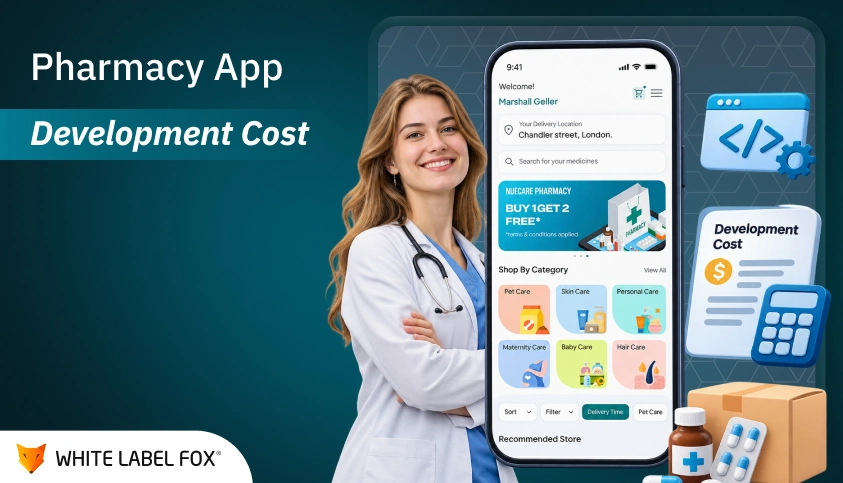
Pharmacy delivery apps usually cost between $25,000 and $120,000+ for a custom build. A basic MVP costs about $25,000 to $40,000. A mid-level app costs $40,000 to $70,000. An advanced, enterprise-grade app costs $70,000 to $120,000 or more. A ready-made pharmacy script from a white-label provider can bring the cost down to roughly $5,000 to $20,000, and you can launch in weeks instead of months.
These are indicative market ranges. Your final cost depends on features, platforms, team location, compliance needs and integrations.
Key Takeaways
- The medicine delivery market keeps growing because people want fast, private and convenient access to healthcare products.
- Your cost depends mostly on app complexity, number of user panels, platforms and compliance requirements.
- A pharmacy app needs four panels: customer, pharmacy or store, delivery partner and admin.
- Prescription upload and verification are not optional. They protect your users and your business.
- A white-label pharmacy script is the fastest and most budget-friendly way to enter the market.
- Start with an MVP app , then add advanced features based on real user feedback.
What Is a Pharmacy Delivery App?
A Pharmacy delivery app development is a mobile or web platform that lets people order medicines, health products and wellness items online and get them at their doorstep. Users can search for medicines, upload a prescription, place an order, pay online and track the delivery in real time.
Business owners often call this model an Uber for medicine delivery app. It works like a ride-hailing platform, but instead of matching riders with drivers, it matches patients with nearby pharmacies and delivery partners.
You may also hear the same product called a medical delivery app, an on demand medicine delivery app, or an online pharmacy app. The core idea stays the same: connect patients, pharmacies and delivery agents on one platform.
Want an Exact Cost for Your Pharmacy App?
Every project is different. Tell us your features, platforms and timeline, and we will send you a clear, no-obligation estimate.
Why Pharmacy Delivery App Development Is a Smart Business Move
Healthcare is moving online. Patients now book doctors, take lab tests and order medicines from their phones. Here is why investing in pharmacy delivery app development makes sense today:
- Rising demand for convenience. Elderly patients, working professionals and people with chronic conditions want medicines delivered without a trip to the store.
- Recurring orders. Many patients buy the same medicines every month. That gives you repeat revenue.
- Smartphone and internet growth. More people can now use digital health services.
- Low entry barrier with white-label solutions. You do not need to build everything from scratch.
- Multiple revenue streams. You can earn from commissions, delivery fees, subscriptions and ads.
How Does an On Demand Medicine Delivery App Work?
The workflow is simple. Here is how a typical order moves through the system:
- The customer opens the app and searches for a medicine or uploads a prescription.
- The nearest pharmacy receives the order and checks the prescription.
- The pharmacist accepts the order and packs the medicines.
- The platform assigns a delivery partner based on location and availability.
- The customer tracks the delivery live on a map.
- The customer pays and receives the order. The app then asks for a rating and review.
Types of Pharmacy Delivery App Business Models
Before you plan your budget, choose the model that fits your goals.
| Business Model | How It Works | Best For |
|---|---|---|
| Single-Pharmacy App | One pharmacy owns the app and delivers its own stock | Existing pharmacy owners going digital |
| Marketplace (Aggregator) Model | Many pharmacies list products. You earn a commission per order | Startups and entrepreneurs |
| Inventory-Based Model | You own the stock, warehouse and delivery fleet | Large retail chains |
| Hybrid Model | Mix of marketplace and your own inventory | Growing businesses that want more control |
Most startups choose the marketplace model. It needs less capital because you do not hold inventory.
Must-Have Features of a Pharmacy Delivery App
A pharmacy delivery app serves four types of users. Each one needs a dedicated panel.
1. Customer App Features
- Easy registration and login with phone number, email or social accounts
- Medicine search with filters by name, brand, category and price
- Prescription upload by camera or gallery
- Smart reorder for repeat medicines
- Multiple payment options including cards, wallets, UPI and cash on delivery
- Real-time order tracking with live map and ETA
- Order history and digital invoices
- Push notifications for order status, offers and refill reminders
- Ratings and reviews for pharmacies and delivery partners
- Multi-language support for a wider audience
2. Pharmacy or Store Panel Features
- Store profile and inventory management
- Order management with accept, reject and update options
- Prescription verification tools
- Stock alerts for low inventory and expiry dates
- Earnings dashboard and payout reports
- Offer and discount management
3. Delivery Partner App Features
- Simple onboarding with document verification
- Online and offline status toggle
- Order requests with accept or reject option
- GPS navigation with the best route
- Proof of delivery through OTP, signature or photo
- Earnings and payment history
4. Admin Panel Features
- Dashboard with live sales, orders and user data
- User, pharmacy and delivery partner management
- Commission and delivery fee settings
- Product and category management
- Coupon and promotion control
- Analytics and reports
- Content and notification management
Advanced Features That Make Your App Stand Out
Once your MVP is live, add these features to beat the competition:
| Advanced Feature | Benefit |
|---|---|
| AI-based medicine recommendations | Suggests generic alternatives and related products |
| Refill reminders | Increases repeat orders and patient adherence |
| Teleconsultation integration | Lets users talk to a doctor and get an e-prescription |
| Subscription plans | Gives free delivery and discounts for monthly members |
| Barcode or QR scanner | Helps users find medicines quickly |
| Chatbot support | Answers common questions 24/7 |
| Lab test booking | Adds another revenue stream |
| Cold-chain tracking | Supports temperature-sensitive medicines |
| Loyalty and referral programs | Improves retention and word of mouth |
| Voice search | Makes the app easier for elderly users |
Pharmacy Delivery App Development Cost Breakdown
Now let us look at the numbers. The cost of pharmacy delivery app development changes with the scope of your project.
Cost by App Complexity
| App Type | Estimated Cost | Timeline | What You Get |
|---|---|---|---|
| Basic (MVP) | $25,000 – $40,000 | 3 – 4 months | Core features, one platform, basic admin panel |
| Mid-Level | $40,000 – $70,000 | 4 – 6 months | All four panels, iOS and Android, payment gateway, live tracking |
| Advanced | $70,000 – $120,000+ | 6 – 9 months | AI features, teleconsultation, deep analytics, third-party integrations |
| Ready-Made Pharmacy Script | $5,000 – $20,000 | 2 – 6 weeks | Pre-built, customizable solution with branding |
Cost by Development Stage
| Development Stage | Share of Budget |
|---|---|
| Discovery and planning | 5% – 10% |
| UI/UX design | 10% – 15% |
| Frontend and backend development | 40% – 50% |
| Quality assurance and testing | 10% – 15% |
| Deployment and launch | 5% |
| Maintenance and support (yearly) | 15% – 20% of build cost |
Cost by Developer Location
| Region | Average Hourly Rate |
|---|---|
| North America | $80 – $150 |
| Western Europe | $60 – $120 |
| Eastern Europe | $35 – $60 |
| India and South Asia | $20 – $45 |
Hiring a team in a lower-cost region can cut your budget by 40% to 60% without lowering quality, as long as you pick an experienced partner.
Factors That Affect Pharmacy Delivery App Development Cost
Several things push your budget up or down. Review each one before you finalize your plan.
- Number of platforms. Building for iOS, Android and web costs more than building for one platform. Cross-platform frameworks like Flutter or React Native can reduce this cost.
- Number of user panels. Four panels cost more than one or two.
- Feature complexity. Real-time tracking, AI recommendations and teleconsultation need more development hours.
- UI/UX design. A custom, polished design costs more than a template. It also improves trust and conversion.
- Third-party integrations. Payment gateways, SMS, maps, e-prescription systems and inventory software all add to the cost.
- Compliance and security. Healthcare apps handle sensitive data. Meeting legal standards needs extra work.
- Development team. Agency, freelancer or in-house team: each option has a different price and risk level.
- Custom build vs. white-label script. A ready-made solution costs much less than a build from zero.
- Maintenance and updates. Plan for bug fixes, server costs, OS updates and new features after launch.
Custom Development vs. Pharmacy Script: Which One Should You Choose?
A pharmacy script is a ready-made software solution. Developers have already built the core features. You only customize the branding, features and design to match your business.
| Factor | Custom Development | Pharmacy Script (White-Label) |
|---|---|---|
| Cost | High | Low to moderate |
| Time to launch | 4 – 9 months | 2 – 6 weeks |
| Customization | Unlimited | High, within the script's framework |
| Risk | Higher | Lower, since the product is already tested |
| Best for | Large enterprises with unique needs | Startups, pharmacies and SMEs |
If you want to test the market fast and keep your budget under control, a white-label pharmacy script is usually the smarter choice. You can always upgrade or scale later.
Recommended Tech Stack for a Medicine Delivery App
The right technology keeps your app fast, secure and scalable.
| Component | Popular Options |
|---|---|
| Mobile App (Cross-Platform) | Flutter, React Native |
| Native Apps | Swift (iOS), Kotlin (Android) |
| Backend | Node.js, Laravel, Python (Django) |
| Database | MySQL, PostgreSQL, MongoDB |
| Maps and Tracking | Google Maps API, Mapbox |
| Payments | Stripe, Razorpay, PayPal, Braintree |
| Notifications | Firebase Cloud Messaging, Twilio |
| Cloud Hosting | AWS, Google Cloud, Microsoft Azure |
| Analytics | Google Analytics, Mixpanel |
Compliance and Legal Requirements You Cannot Ignore
Medicines are regulated products. A good medical delivery app must follow the laws of the region where it operates. Rules differ by country, so always speak with a local legal expert before launch.
- Pharmacy licensing. Every pharmacy on your platform needs a valid license. Verify it during onboarding.
- Prescription rules. Prescription-only medicines must need a valid prescription from a registered doctor. Your app must check it before dispatch.
- Data privacy. Follow laws like HIPAA in the United States, GDPR in Europe and the Digital Personal Data Protection Act in India.
- Payment security. Use PCI-DSS compliant payment gateways.
- Controlled substances. Many regions restrict or ban the online sale of certain drugs. Keep them off your platform unless the law clearly allows it.
- Storage and delivery standards. Some medicines need temperature control and safe packaging.
Benefits of Pharmacy Delivery App Development
Benefits for Business Owners
- Wider reach. You serve customers beyond your store's location.
- Higher sales. Easy reordering and offers increase order value and frequency.
- Lower operating costs. Digital orders reduce manual work and phone calls.
- Better inventory control. Real-time data helps you avoid stockouts and expired stock.
- Customer data and insights. You learn what people buy and when.
- Stronger brand loyalty. A smooth app experience keeps patients coming back.
- Multiple revenue streams. Earn from commissions, delivery fees, subscriptions and advertising.
Benefits for Customers
- Convenience. Order from home at any time.
- Time savings. No queues and no travel.
- Privacy. Patients can order sensitive medicines discreetly.
- Access for everyone. Elderly, disabled and rural patients get easier access.
- Price comparison. Users can compare prices and find generic options.
- Transparency. Live tracking shows exactly where the order is.
Benefits for Pharmacies
- More orders without more staff.
- Online visibility in their local area.
- Automated order and payment management.
How Do Medicine Delivery Apps Make Money?
A clear revenue model helps you plan your budget and your return on investment.
| Revenue Stream | How It Works |
|---|---|
| Commission per order | Take 8% – 20% from each order placed through your platform |
| Delivery fees | Charge a flat or distance-based fee |
| Subscription plans | Offer monthly or yearly membership with free delivery |
| Featured listings and ads | Let pharmacies and brands pay for top placement |
| Pharmacy onboarding fees | Charge a setup or yearly listing fee |
| Teleconsultation and lab test commissions | Earn from partner services |
Step-by-Step Process of Pharmacy Delivery App Development
- Research the market. Study your competitors, your target audience and local regulations.
- Define your business model. Choose between single-store, marketplace, inventory-based or hybrid.
- List your features. Separate must-have features from nice-to-have ones.
- Choose your development approach. Decide between custom development and a white-label script.
- Design the user experience. Create wireframes and clean, simple screens.
- Develop the app. Build the frontend, backend, admin panel and integrations.
- Test thoroughly. Check functionality, security, speed and device compatibility.
- Launch. Publish on the App Store and Google Play. Start with one city.
- Market the app. Use local SEO, social media, partnerships and referral offers.
- Collect feedback and improve. Add new features based on real user needs.
Tips to Reduce Pharmacy Delivery App Development Cost
- Start with an MVP. Launch core features first and add more later.
- Use cross-platform development. One codebase can serve both iOS and Android.
- Pick a white-label pharmacy script. You skip months of development.
- Reuse existing APIs. Use ready-made payment, map and SMS services.
- Outsource wisely. Work with an experienced team in a cost-effective region.
- Plan your scope before development begins. Changes in the middle of a project raise costs quickly.
Common Challenges and How to Solve Them
| Challenge | Solution |
|---|---|
| Fake or invalid prescriptions | Add manual and AI-based verification by licensed pharmacists |
| Slow deliveries | Use smart dispatch that assigns the nearest partner |
| Low trust from new users | Show pharmacy licenses, reviews and secure payment badges |
| Inventory mismatch | Sync pharmacy stock with the app in real time |
| Data security risks | Use encryption, secure servers and regular security audits |
| Pharmacy onboarding | Offer easy onboarding, training and a simple dashboard |
Why Choose WhiteLabelFox for Pharmacy Delivery App Development?
If you want to launch fast without a huge budget, WhiteLabelFox can help you get there. We build white-label, ready-to-launch solutions that you can brand as your own. Our team understands how on demand businesses work, and we help you launch an on demand medicine delivery app that fits your goals.
With WhiteLabelFox, you can:
- Launch your pharmacy delivery app in a short time
- Customize features, design and branding to match your business
- Get customer, pharmacy, delivery partner and admin panels in one package
- Scale your platform as your business grows
- Get technical support from experienced developers
Ready to build your own Uber for medicine delivery app? Contact the WhiteLabelFox team today for a free consultation and a custom quote.
Conclusion
Pharmacy delivery app development is a strong opportunity for entrepreneurs and pharmacy owners. Patients want convenience, speed and privacy, and a well-built medical delivery app gives them all three.
The cost depends on your features, platforms, compliance needs and development approach. If you have a large budget and unique needs, go for custom development. If you want to move fast and reduce risk, a white-label pharmacy delivery app is the smarter path.
Whichever route you take, start small, focus on user experience and improve with real feedback. Ready to get started? Talk to the WhiteLabelFox team and turn your idea into a working pharmacy delivery app.
Frequently Asked Questions (FAQs)

Viral Kacha - CEO & Sales Head
Author
With years of expertise in the on-demand app industry, Viral Kacha leads White Label Fox with a vision to empower startups and enterprises with top-tier, ready-made app solutions. His strategic approach, strong leadership, and deep market understanding drive business growth, innovation, and client success. He is dedicated to helping businesses scale efficiently with cutting-edge technology.