Quick Answer
Taxi businesses should invest in white label taxi app development because it gives them a ready-made, fully branded taxi booking app at a lower cost and in far less time than a custom build. You keep your brand, your drivers, your customer data, and your fare revenue. You also stop paying a share of every ride to a third-party aggregator.
Key Takeaways
- The global taxi market is set to grow from USD 254.36 billion in 2026 to USD 366.91 billion by 2031, according to Mordor Intelligence.
- Ride-hailing already holds about 75% of the taxi market, so riders now expect to book from an app.
- A white-label taxi booking app launches faster and costs less than building from scratch.
- Owning your app means you own your brand, your data, and your profit margin.
- The right taxi app development company will also customize features, payments, and languages for your city.
Why Is Everyone Talking About White-Label Taxi App Development?
A few years ago, a taxi owner could run a business with a phone number and a radio. Today, riders open an app, see a fare, and book a car in under a minute. If your business is not in that app, your customers will find someone who is.
That shift is why taxi app development is now a top priority for fleet owners, local taxi companies, and new entrepreneurs. Building an app from zero takes months and a large budget, though. This is where white-label taxi app development helps. You start with a tested product and make it your own.
In this guide, we explain what a white-label taxi app is, why it makes business sense, what it costs you in time and effort, and how to launch it step by step. We also answer the questions most taxi owners ask before they invest.
Stop Paying Commission on Every Ride
Launch your own white-label taxi booking app, keep your fares, and own your customer data. White Label Fox has helped 300+ startups go live.
What Is White-Label Taxi App Development?
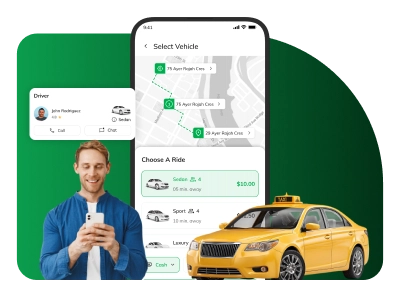
White-label taxi app development means a technology company builds a complete taxi booking platform, and you launch it under your own brand name, logo, colors, and domain. Your riders see your brand. They never see the developer behind it.
A white-label taxi booking app usually has four parts:
- Rider app: Customers book rides, see fares, track drivers, and pay.
- Driver app: Drivers accept trips, navigate, and view their earnings.
- Admin Dashboard: You manage drivers, fares, bookings, payments, and reports.
- Dispatch system: The platform matches each ride request with the nearest available driver.
How does an on-demand taxi app work?
- A rider enters a pickup point and destination.
- The app shows the fare estimate and available vehicle types.
- The system sends the request to nearby drivers.
- A driver accepts, and the rider sees the driver's name, car details, and live location.
- The driver completes the trip, and the rider pays in the app.
- Both sides rate the trip, and you see every detail in your admin dashboard.
The whole process runs automatically. No call center, no manual dispatch, and no guesswork.
Why Are Taxi Businesses Moving to Apps?
Three trends explain the shift.
1. The market keeps growing. Mordor Intelligence values the taxi market at USD 236.36 billion in 2025 and expects it to reach USD 366.91 billion by 2031, a CAGR of 7.62%. The same report shows that ride-hailing held 74.85% of the market in 2025. In India, Mordor Intelligence estimates the taxi market at USD 23.98 billion in 2026, with ride-hailing producing 65.10% of 2025 revenue.
2. Riders expect app convenience. People want live tracking, upfront fares, cashless payment, and trip history. Phone bookings cannot offer all of that.
3. Aggregators control the customer. When customers book through a big platform, that platform owns the relationship. Your drivers do the work, but the aggregator collects the data, the reviews, and a cut of each fare.
A taxi booking app of your own changes that balance.
10 Reasons to Invest in White-Label Taxi App Development
1. You launch much faster
A custom taxi app can take many months to design, build, and test. A white-label solution already has the core features working. You customize the branding and settings, test them, and go live. White Label Fox, for example, offers ready-to-deploy taxi platforms that can launch in as little as five days, depending on how much customization you need.
2. You spend less money upfront
Custom development needs designers, developers, testers, and project managers for a long period. With a white-label app, you share the cost of the core product across many clients. You pay for what you need to adapt, not for what already exists.
3. You build your own brand
Riders remember brands, not software vendors. Your name, your logo, and your colors appear on every screen, ride receipt, and notification. Over time, this builds trust and repeat bookings. A branded taxi booking app also makes your business look established, even in its first month.
4. You stop paying commission to aggregators
Many taxi operators give a share of every fare to aggregator apps. That share adds up fast. With your own app, you decide the commission model, and you keep the margin.
A simple example (illustrative numbers only): Imagine a fleet of 50 cars that earns USD 120 per car per day in fares booked through an aggregator. That is USD 180,000 a month. If the aggregator keeps 20%, you lose USD 36,000 every month. Even if only half of your rides move to your own app, the savings can cover the app's running costs and still leave a healthy profit. Your actual numbers will differ, so check your own contracts.
5. You own your customer data
Your app records who books, when, where, and how often. You can use that data to send offers, bring back inactive riders, and plan where to place drivers at busy hours. Aggregators keep this information to themselves.
6. You can add more revenue streams
A good on-demand taxi booking app does more than book city rides. You can add:
- Airport and outstation trips
- Rental cars with or without a chauffeur
- Bike taxis for short, quick rides
- Carpooling and shared rides
- Corporate accounts and monthly billing
- Ride packages and subscriptions
Each new service brings new income from the same app and the same drivers.
7. You control pricing, rules, and quality
The admin dashboard lets you set base fares, per-kilometer rates, surge rules, waiting charges, and cancellation fees. You can also approve drivers, check documents, and remove poor performers. You run the business the way you want.
8. You can scale without starting over
A white-label platform is built to grow. You can start with one city and a small fleet, then add drivers, vehicle types, languages, and cities. You do not need to rebuild the app each time.
9. You reduce technical risk
A white-label app has already been used by real businesses. Common bugs are fixed, payment flows are tested, and the core system is proven. This lowers the risk that a new product fails on launch day.
10. You compete better against big platforms
You cannot beat a global aggregator on advertising spend. You can beat it on local knowledge. Offer women-only rides, fixed airport fares, local-language support, cash payment, or better driver earnings. A white-label app gives you the tools to deliver these advantages.
White-Label vs Custom Build vs Aggregator: Which Is Better?
| Factor | White-Label Taxi App | Custom-Built App | Aggregator Platform |
|---|---|---|---|
| Time to launch | Launch in 5 days | Several months | Quick, but you depend on them |
| Upfront cost | Low to medium | High | Low |
| Brand ownership | Your brand | Your brand | Their brand |
| Customer data | You own it | You own it | They own it |
| Commission per ride | You decide | You decide | They charge it |
| Customization | Medium to high | Full | Very limited |
| Technical risk | Low | High | Low |
| Best for | Most taxi businesses and startups | Large firms with unique needs | Drivers who want quick rides |
Our view: For most taxi businesses, white-label taxi app development gives the best balance of speed, cost, and control. A custom build makes sense only when your business model is truly unique and your budget is large.
How Does a Taxi Booking App Make Money?
Your on-demand taxi booking app can earn through several channels:
- Commission on each ride: You keep a percentage of every fare.
- Subscription plans for drivers: Drivers pay a weekly or monthly fee instead of a commission.
- Booking and service fees: A small fee is added to each booking.
- Cancellation fees: Riders pay when they cancel late.
- Surge pricing: Fares rise when demand is high.
- Corporate contracts: Businesses pay you for staff transport.
- In-app advertising: Local brands pay to reach your riders.
- Add-on services: Rentals, outstation trips, and airport transfers.
Start with one or two models. Add more as your rider base grows.
Who Should Invest in White-Label Taxi App Development?
- Existing taxi and fleet owners who want to cut aggregator commission and own their customers.
- Startup founders who want to launch a ride-hailing business with a lower budget.
- Corporate transport providers who manage staff and employee rides.
- Airport, tourist, and outstation operators who need pre-booked, fixed-price trips.
- Digital agencies and IT companies who want to offer taxi apps to their own clients under their own name.
If you want to sell taxi apps to clients, a white-label partner lets you add a product without building a development team.
How to Launch Your Taxi App Step by Step
- Research your market. Study local demand, competitors, fare levels, and rules.
- Choose your business model. Decide between commission, subscription, or a mix.
- Pick a reliable development partner. Review their work, demos, support, and source code terms.
- Customize the app. Add your logo, colors, vehicle types, fare rules, payment methods, and languages.
- Test everything. Check booking, tracking, payments, notifications, and the admin dashboard.
- Onboard drivers. Verify documents and train drivers on the app.
- Launch and promote. Start in one area, use referral offers, and collect feedback.
- Improve and expand. Add services, cities, and features based on real data.
What Should You Look for in a Taxi Booking App Development Company?
Not every vendor is equal. Before you sign, ask these questions:
- Do you provide the full source code, and do I get 100% ownership?
- Can you show a live demo of the rider, driver, and admin apps?
- How much can you customize, and what costs extra?
- Which payment gateways and maps do you support?
- How do you handle security, data privacy, and server scaling?
- What support do you offer after launch?
- Can you show real clients and case studies?
- Is pricing clear, with no hidden fees?
Also check reviews on independent sites such as Clutch, GoodFirms, and Trustpilot.
Taxi App Trends to Watch in 2027
- Fare bidding: Riders suggest a price, and drivers reply with offers. This model works well in price-sensitive markets.
- Multi-service apps: One app offers rides, bike taxis, rentals, and delivery.
- Electric vehicles: Mordor Intelligence projects the EV taxi market to grow from USD 36.81 billion in 2026 to USD 110.56 billion by 2031.
- Smarter dispatch: AI-based matching reduces wait time and empty miles.
- Safety tools: Trip sharing, SOS alerts, and verified drivers are now standard expectations.
Real Examples: What White Label Fox Has Built
Two projects show how flexible white-label taxi app development can be:
- Tuma Go (Egypt): A taxi bidding app where riders name their fare and drivers respond with live offers. It supports five languages, five currencies, and right-to-left text, all managed from one admin dashboard. It has crossed 10K+ downloads. read the case study.
- Foxizz (Kazakhstan): A multi-service transport app that combines ride-hailing, intercity travel, bike rides, taxi pooling, and car rental in one platform, with tour and transfer features.
See more projects on the case studies page.
Why Choose White Label Fox for Taxi App Development?
White Label Fox is a clone and on-demand app development company with 9+ years of experience and 300+ startups powered. Here is what you get:
- Ready-to-deploy taxi platform: Fox-Taxi includes rider, driver, and admin apps.
- Fast launch: Ready-to-deploy solutions can go live in as little as five days.
- Full ownership: You receive the source code and own your platform.
- Customization: Add your own features, languages, payment methods, and services.
- Wider product range: Add bike taxi, fare bidding, carpooling, or car rental as you grow.
- Ongoing support: A dedicated support manager helps after launch.
Check the taxi app clone pricing page or the white-label taxi app overview to see what fits your budget.
Conclusion
The taxi market is growing, and riders now book on their phones. A white-label taxi app lets you join that shift quickly, keep your brand front and center, and keep more of every fare. It costs less than a custom build, carries less risk, and gives you the data you need to grow.
If you run a taxi business or plan to start one, now is a good time to move. Pick a trusted partner, start in one city, and improve as you learn.
Ready to launch your own taxi app? Get a free quote from White Label Fox and see a live demo of your taxi booking platform.
Frequently Asked Questions (FAQs)

Deep Faldu - CTO
Author
As the Chief Technology Officer, Deep Faldu spearheads innovation at White Label Fox, ensuring seamless, scalable, and high-performance app solutions. His technical expertise, problem-solving skills, and commitment to excellence help businesses thrive in the competitive digital landscape. He continuously explores new technologies to enhance product efficiency and user experience.