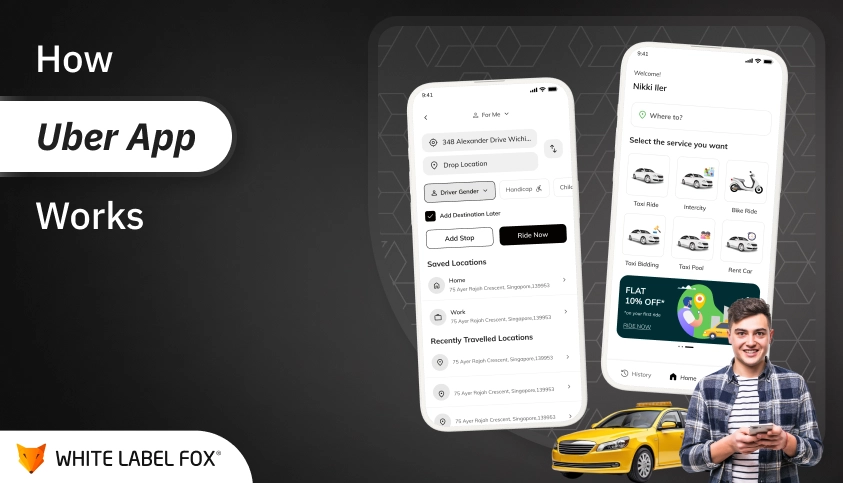
If you have ever opened a smartphone app, tapped a button, and had a car pull up at your door within minutes - you already know the output. But understanding how does Uber work under the hood is a completely different conversation. One that matters enormously if you are an entrepreneur, a startup founder, or a business decision-maker exploring the on-demand economy.
Since its 2009 launch, Uber has grown into a $140+ billion company operating in 70+ countries, fundamentally transforming how cities move. But how does Uber work, exactly? What makes the app feel so seamless on both sides of the transaction - for the rider tapping a screen and the driver heading toward a pin?
This guide breaks down the Uber business model explained in full - the technology, the revenue streams, the algorithms, and why millions of entrepreneurs are racing to build a taxi app like Uber. Whether you're a curious user or a founder exploring uber clone app development, you're in the right place.
What Is Uber and Why Does Its App Model Still Set the Standard?
Uber launched in 2009 and fundamentally disrupted the taxi industry by solving a two-sided problem: riders could not find reliable cabs, and drivers could not find consistent income.
The Uber business model explained simply is this - it is a technology platform that connects people who need rides with people who can provide them, taking a cut of every transaction in between.
What makes the ride hailing app work so compelling for entrepreneurs is the scalability. Uber does not own a single vehicle. It owns the software, the brand, and the data.
Every driver is an independent contractor. Every rider is a paying customer acquired through the app. The company earns without the overhead of a traditional fleet business.
This on demand taxi app business model has since been replicated across dozens of verticals - food delivery, freight, healthcare, handyman services - because the underlying logic is universal. Understand Uber's model, and you understand the blueprint for an entire category of digital business.
Launch Your Own Taxi App in 5 Days
You now know how Uber's model works. The next step is building one for your market - without the $200K custom dev bill or 12-month timeline.

How Does the Uber App Work? Step-by-Step Breakdown
Understanding how the Uber app works is best done by walking through a complete ride lifecycle - from the moment a rider opens the app to the moment they step out of the car.
Step 1: Rider Opens the App and Sets a Destination
The rider launches the app, which immediately accesses their GPS location. They enter a destination, select a ride type (UberX, Uber Comfort, Uber Black, etc.), and see an upfront fare estimate. This transparency - knowing the price before booking - was a deliberate UX decision that built early consumer trust.
Step 2: The Ride-Matching Algorithm Fires
Here's where the technology gets interesting. Uber's ride-matching algorithm doesn't simply assign the nearest driver. It uses a sophisticated system that simultaneously weighs:
- Driver proximity - geographic distance to the rider
- Driver ratings and acceptance rates - quality signals
- Traffic and ETA calculations - powered by real-time map data
- Demand density - how many riders are in the area vs. available drivers
The result? A match is typically made in under 15 seconds. This on demand app how it works logic is the heartbeat of the entire platform.
Step 3: Driver Accepts the Request
On the how Uber driver app works side, the driver sees a notification with pickup location, estimated trip length, and projected earnings. They have a short window to accept.
If they decline or don't respond, the request routes to the next best match - keeping wait times low and ensuring supply responds to demand.
Step 4: Real-Time GPS Tracking Begins
Once matched, both parties track each other on a live map. Real-time GPS tracking in the taxi app is one of the most safety-critical features - riders know exactly who's coming and when, drivers navigate efficiently, and Uber's backend monitors every active trip for anomalies.
Step 5: The Trip Happens
The driver arrives, confirms pickup, and the ride begins. The app tracks the route in real time, calculating fare adjustments if traffic extends the journey. Both parties stay within the same platform - no separate navigation app needed.
Step 6: Cashless Payment and Mutual Rating
When the ride ends, the cashless payment taxi app mechanism fires automatically. The stored payment method is charged, a receipt is emailed, and both rider and driver rate each other.
This mutual rating system is one of Uber's most powerful quality-control mechanisms - crowd-sourced accountability at scale.
The Uber Business Model Explained: How the Platform Is Structured
How does Uber work as a business - not just an app? The answer is the two-sided marketplace app model.
Uber operates a platform that serves two distinct user groups simultaneously: riders (demand side) and drivers (supply side). The platform's entire value depends on having enough of both. Too few drivers, and riders wait too long.
Too few riders, and drivers earn too little. Uber's growth strategy in every new market it entered was specifically designed to seed both sides of this equation simultaneously.
This network-dependent structure is why Uber network effects explained matter so much. As more riders join the platform, drivers earn more - which attracts more drivers. As more drivers join, wait times drop - which attracts more riders.
This self-reinforcing loop becomes a compounding moat that is extraordinarily difficult for competitors to break once it has been established at scale.
Uber Revenue Model: Where the Money Actually Comes From
The Uber revenue model is diversified across several streams, which is part of why the business is so defensible.
1. Commission on Every Ride
The primary revenue engine. Uber takes a commission - typically between 20% and 30% of every fare - from the driver's earnings. The exact Uber commission model varies by market, city regulations, and driver agreements, but this base mechanism drives the majority of top-line revenue. At billions of trips per year, even a modest per-trip margin generates significant aggregate income.
2. Surge Pricing Upside
When surge multipliers are active, the increased fare flows proportionally to both the driver and Uber. During peak periods, Uber's commission on a 2x surge ride is effectively double its standard take. Uber driver earnings model during surges is also higher, which is why drivers strategically position themselves near high-demand zones.
3. Subscription and Membership Plans
Uber One (formerly Uber Pass) is a subscription offering that gives riders discounts on trips and Uber Eats orders in exchange for a monthly or annual fee. This creates predictable recurring revenue that is independent of trip volume fluctuations.
4. Adjacent Verticals: Uber Eats, Freight, and More
The same on demand app architecture that powers ride hailing was extended to food delivery (Uber Eats), freight logistics (Uber Freight), and medical transport. Each vertical operates on the same commission and marketplace model, multiplying the revenue opportunity without rebuilding the underlying platform.
5. Advertising
Uber's rider app and Uber Eats now carry in-app advertising. Restaurants and brands pay to appear prominently on the platform - a high-margin revenue layer that requires zero incremental operational effort.
The Technology Stack Behind the Uber Taxi Booking App Model
The uber taxi booking app model works because of a sophisticated, invisible technology layer that most riders never think about.
GPS and Mapping Infrastructure
Uber relies on a combination of Google Maps, proprietary mapping data, and third-party providers for routing, ETA calculation, and geofencing. Accurate real-time location data is non-negotiable for the product to function at any scale.
Matching and Dispatch Engine
Uber's proprietary dispatch system processes millions of data points per second. It's essentially a continuous optimization problem - minimizing wait times and maximizing driver utilization across an entire city simultaneously. No human dispatchers required.
Payment Infrastructure
Stripe, Braintree, and regional payment gateways power Uber's cashless payment system, supporting credit cards, debit cards, PayPal, digital wallets, and local payment methods across different markets.
Communication Layer
In-app calling and messaging keep drivers and riders connected without exposing personal phone numbers - a privacy-preserving feature that also keeps all communication logged within the platform for dispute resolution.
Driver Earnings and Payout System
The Uber driver earnings model is calculated as: base fare + per-minute rate + per-mile rate + surge multiplier (when active) − Uber's commission. Drivers can cash out instantly via Uber's Instant Pay feature - a retention driver that competitors have been forced to match.
Core Features of a Taxi Booking App Like Uber
Any competitive taxi booking app needs to cover the rider-facing and driver-facing feature sets, plus a robust admin layer. Here is the essential taxi app features list:
Rider App
- User registration and profile management
- Ride booking with real-time ETA
- Real-time GPS tracking
- Multiple vehicle category selection
- In-app messaging and call masking
- Cashless payment with multiple options
- Ride history and digital receipts
- Rating and review system
- Promo code and referral system
Driver App
- Driver registration and document verification
- Trip request notifications with accept/decline
- Navigation with traffic-aware routing
- In-app earnings tracker
- Surge zone indicators on the map
- Weekly payout processing
Admin Panel
- Live fleet monitoring dashboard
- Fare configuration and surge pricing controls
- Driver and rider management
- Dispute resolution tools
- Analytics and revenue reporting
- Commission management per zone or category
How Does Uber Work for Drivers? Flexibility with Trade-offs
From the driver's perspective, how does Uber work is about independence with guardrails. Drivers are classified as independent contractors - they set their own hours, choose their markets, and earn per trip rather than a fixed wage.
The platform handles everything: customer acquisition, payment processing, navigation, and reputation management. In return, Uber takes its commission and controls pricing.
Drivers have no input on fare rates. This tension between flexibility and control defines the driver-platform relationship and remains one of the most debated dimensions of the gig economy model globally.
Why Entrepreneurs Are Investing in Taxi Booking App Development
The success of Uber's model has sparked a global wave of taxi booking app development. From Southeast Asia's Grab to the Middle East's Careem to India's Ola, the how does ride-hailing app work playbook has been applied across dozens of markets and adjacent verticals.
For entrepreneurs and investors, the appeal is structural:
- Asset-light scalability - no fleet, no inventory, no warehouses
- Recurring commission revenue - earned on every transaction
- Data compounding advantages - rich behavioral data powers product improvement
- Network effect defensibility - harder to displace once established in a city
- Vertical expansion - the model transfers seamlessly to food delivery, freight, healthcare rides, and more
This is exactly why searches for how to build an app like uber have surged among tech founders globally. The architecture is proven - the opportunity lies in finding underserved markets, niche segments, or geographies where dominant players haven't yet entrenched.
What Does It Cost to Build a Taxi App Like Uber?
Ride-hailing app development cost varies based on scope, team geography, and feature depth. Here's a realistic breakdown for a full MVP:
| Component | Estimated Cost Range |
|---|---|
| UI/UX Design | $5,000 – $15,000 |
| Rider App (iOS + Android) | $20,000 – $40,000 |
| Driver App (iOS + Android) | $15,000 – $30,000 |
| Admin Dashboard | $10,000 – $20,000 |
| Backend / API Development | $20,000 – $50,000 |
| GPS & Maps Integration | $5,000 – $10,000 |
| Payment Gateway Integration | $5,000 – $10,000 |
| QA Testing & Launch | $5,000 – $15,000 |
| Total Estimate | $85,000 – $190,000+ |
An uber clone app development approach - using a pre-built white-label solution - can reduce total investment to $5,000–$40,000 and compress time-to-market from 12 months to 5 business days. For founders focused on early-stage market validation before committing to full custom development, this is often the smarter entry point.
Ready to Launch Your Own Taxi Booking App?
Understanding how does Uber work is step one. Building your own version of that model - for your market, your brand, your revenue - is the real opportunity.
At White Label Fox, we specialize in exactly this. We have been building and deploying white-label on-demand app platforms for 9+ years, working with startups and enterprises across global markets. Our Uber clone app comes fully equipped with:
- ✅ Rider App + Driver App + Admin Panel
- ✅ Real-Time GPS Tracking
- ✅ Dynamic Surge Pricing Engine
- ✅ Cashless Payment Integration
- ✅ Ride Matching Algorithm
- ✅ White-Labeled to Your Brand
- ✅ Live in 5 Business Days
Email us [email protected] for a free live demo or visit our website - White Label Fox
Stop analyzing the Uber model. Start owning one.
Frequently Ask Questions

Deep Faldu - CTO
Author
As the Chief Technology Officer, Deep Faldu spearheads innovation at White Label Fox, ensuring seamless, scalable, and high-performance app solutions. His technical expertise, problem-solving skills, and commitment to excellence help businesses thrive in the competitive digital landscape. He continuously explores new technologies to enhance product efficiency and user experience.