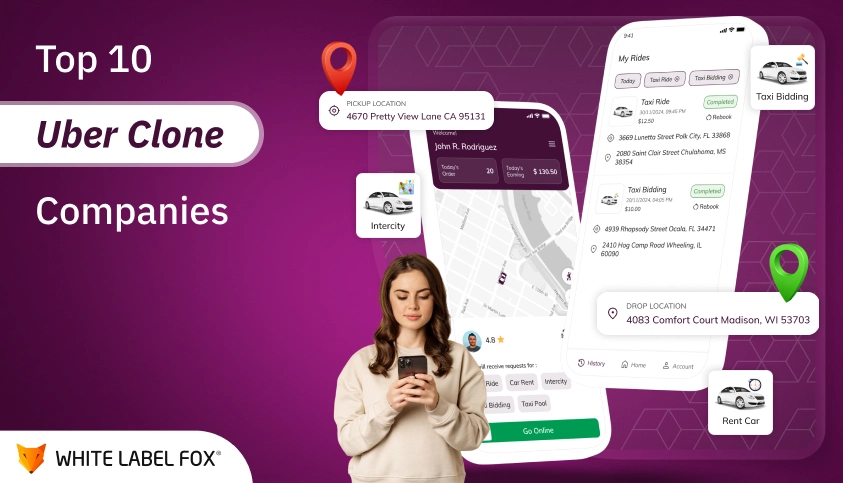
Launching a ride-hailing business in 2026 no longer means spending a year and a six-figure budget on custom development. The global ride-hailing market is projected to grow from $315.49 billion in 2026 to $716.64 billion by 2034, and most new entrants are getting to market with one shortcut: an Uber clone app.
The challenge is not finding an Uber clone app development company - it is choosing the right one. Dozens of vendors promise the same thing, but they differ widely in pricing, delivery time, source code ownership and post-launch support. Pick wrong, and you inherit buggy software with no support team behind it.
We put this list together to save you that research. Below you will find the top Uber clone companies in 2026, compared on the factors that actually matter to a founder: what you pay, what you own, how fast you launch and how well the platform scales.
Why Startups Choose Uber Clone Apps Over Custom Development
Before the list, a quick reality check on why clone solutions dominate ride-hailing app development for startups.
Building a taxi platform from scratch means designing and coding three separate products - a rider app, a driver app and an admin panel - plus the dispatch engine, GPS tracking, payments and notifications that connect them. Industry estimates put custom development at $20,000 to $50,000 on the conservative end, with 6 to 12 months of build time before your first ride is ever booked.
An Uber clone script flips that equation. The core platform is already built and tested in live markets. Your development partner rebrands it, adjusts features for your city and regulations, and deploys it under your name - usually within one to four weeks. You are not paying to reinvent ride-matching; you are paying for speed, reliability and a team that has already solved these problems.
If you want a deeper look at what happens under the hood, our guide on how the Uber app works breaks down the full ride lifecycle.
How We Evaluated These Companies
Every company on this list was assessed against six criteria:
- Pricing transparency: is the cost published or hidden behind sales calls?
- Delivery timeline: how fast can you realistically go live?
- Source code ownership: do you own the platform outright, or rent it?
- Feature depth: rider and driver apps, admin dashboard, dispatch software, payment options.
- Customization flexibility: languages, currencies, local payment gateways, region-specific features.
- Post-launch support: maintenance, updates and technical help after deployment.
Quick Comparison: Top Uber Clone Companies 2026
| # | Company | Best For | Starting Price | Typical Delivery |
|---|---|---|---|---|
| 1 | White Label Fox | Fastest launch with full ownership | Custom quote | 5 working days |
| 2 | Quickworks | Cloud-native hybrid fleets | Custom quote | 2-4 weeks |
| 3 | OpenXcell | Small to mid-size fleet builds | Custom quote | 4-8 weeks |
| 4 | Space-O Technologies | Early-stage custom builds | Custom quote | 6-12 weeks |
| 5 | MindInventory | Post-launch support focus | Custom quote | 4-8 weeks |
| 6 | Octal IT Solution | Multi-zone white label setups | Custom quote | 3-6 weeks |
| 7 | Codiant | UI/UX-led development | Custom quote | 4-8 weeks |
| 8 | Promatics Technologies | Mid-scale regional apps | Custom quote | 4-8 weeks |
| 9 | Blocktunix | Analytics and security-first builds | Custom quote | 4-8 weeks |
| 10 | CedCommerce | Commerce-integrated mobility | Custom quote | 4-8 weeks |
Timelines are indicative, based on typical project scopes as of July 2026. Most vendors quote per project - always confirm what is included before signing.
10 Best Uber Clone App Development Companies in 2026
1. White Label Fox

White Label Fox tops this list for one simple reason: it removes the two biggest risks founders face - slow launches and rented software. Its Uber clone app is a fully white-label taxi app solution built on Flutter and Laravel, delivered with complete source code ownership. Once you buy it, the platform is yours to modify, extend and scale without recurring license fees.
The package covers everything a ride-hailing operation needs on day one: rider and driver apps for iOS and Android, a web-based admin dashboard, AI-powered dispatch, ETA prediction, dynamic pricing and route optimization. It supports 12 ride service types out of the box - from instant taxi and ride bidding to intercity travel, carpooling, bike taxi, EV fleets and women-only rides - so you can diversify revenue without new development.
Key highlights:
- Go live in 5 working days - the fastest launch timeline on this list.
- Full source code ownership, no recurring platform fees.
- Serving businesses across 88+ countries with multi-language and multi-currency support.
- Built-in monetization: commissions, surge pricing, driver subscriptions, corporate billing and advertising.
- Free demo before you commit.
Best for: startups and taxi operators who want the shortest path from purchase to live operations, with a platform they fully own.
2. Quickworks

Quickworks offers end-to-end ride-hailing development on a cloud-native platform designed to serve both startups and larger fleets. Its white-label solution stretches beyond standard taxi booking into rentals, chauffeur services and hybrid business models, with real-time tracking, automated dispatch, multi-payment integration and analytics included. That flexibility makes it worth a look if your business model mixes ride types.
Best for: operators running hybrid models - taxis plus rentals or chauffeur services.
3. OpenXcell

OpenXcell is an established development agency with a performance-driven approach to ride-hailing app development. Rather than selling a fixed script, it builds and adapts platforms suited to small and mid-size fleets, which means more flexibility in scope but longer timelines than off-the-shelf alternatives.
Best for: small to mid-size fleet operators who want an agency-style engagement.
4. Space-O Technologies

Space-O Technologies takes a budget-friendly custom development approach, making it a practical option for early-stage businesses that want some bespoke engineering without full enterprise pricing. Expect a longer road to launch than with pre-built platforms - this is a build engagement, not an off-the-shelf deployment.
Best for: early-stage teams that want agency collaboration on a moderate budget.
5. MindInventory

MindInventory has built its reputation on workflow management and post-launch maintenance - an area where many development shops fall short. If your biggest worry is what happens after launch (updates, bug fixes, OS compatibility), its ongoing support focus is the standout reason to shortlist them.
Best for: founders who prioritize long-term maintenance over launch speed.
6. Octal IT Solution

Octal IT Solution delivers white-label taxi apps with support for multi-driver and multi-zone configurations, which matters once you operate across several cities or districts with different pricing and dispatch rules. A sensible pick for operators planning multi-city coverage from the start.
Best for: businesses launching in multiple zones or cities simultaneously.
7. Codiant

Codiant approaches ride-hailing development UI/UX-first, with route optimization and payment integration as core strengths. If your market is competitive and rider experience is your differentiator, a design-led development partner is a reasonable trade against faster script-based launches.
Best for: operators competing on app experience in crowded markets.
8. Promatics Technologies

Promatics Technologies builds mid-scale ride-hailing apps with real-time tracking and driver onboarding workflows included. It sits comfortably in the middle of the market - more structure than a budget script, less cost than an enterprise build.
Best for: regional operators who need a solid mid-market platform.
9. Blocktunix

Blocktunix takes a technology-first approach, with predictive analytics, smart routing and decentralized security architecture as its calling cards. It suits founders who see data and security as competitive advantages rather than checkboxes.
Best for: data-driven operators with strong security requirements.
10. CedCommerce

CedCommerce is primarily an ecommerce development company that also builds custom mobility solutions. It is the unconventional pick on this list - most relevant if your ride-hailing plans connect to a broader commerce play, such as deliveries alongside rides.
Best for: businesses combining transportation with ecommerce or delivery.
Launch Your Taxi Business in 5 Days
See exactly how your branded ride-hailing app will look and work before you spend anything. Get a personalized walkthrough of the rider app, driver app and admin panel.

Uber Clone Script Price Comparison: What You Will Actually Pay
Uber clone script price is the first question every founder asks, and the honest answer is: it depends on what you are buying. The market splits into three tiers.
| Tier | Price Range | What You Get | Watch Out For |
|---|---|---|---|
| Budget scripts | $950-$4,000 | Basic rider/driver apps, standard admin panel | Limited support, extra fees for customization, unclear code ownership |
| Mid-range white label | $4,000-$15,000 | Full platform, branding, localization, source code, support period | Feature lists vary widely - compare line by line |
| Custom / enterprise | $20,000-$50,000+ | Bespoke features, dedicated team, deep integrations | 6-12 month timelines, ongoing development costs |
Four factors move the price within each tier:
- Source code ownership: platforms sold as licenses look cheaper upfront but cost more over time. Full ownership means no recurring platform fees and complete freedom to modify.
- Feature scope: each additional ride type, payment gateway or third-party API integration adds cost.
- Customization depth: rebranding is cheap; reworking core flows is not.
- Support and maintenance: a platform without post-launch support becomes your problem the day something breaks.
For a detailed breakdown of packages and what each includes, see our Uber clone script pricing guide.
How to Choose the Right Uber Clone Development Company
A shortlist is only half the job. Run every vendor - including us - through this checklist before you sign anything.
- Demand a live demo, not screenshots. Any serious taxi app development company will show you working rider and driver apps. If they cannot, walk away.
- Get source code ownership in writing. This is the single most expensive mistake founders make. Confirm in the contract that full source code transfers to you on final payment - not access, not a license, ownership.
- Check real client deployments. Ask which live apps run on their platform and test one from the app store. Reviews on the vendor's own site are marketing; live apps are evidence.
- Verify localization support. If you operate outside the US, you need local payment gateways, your currency, your language and compliance with local transport regulations. Ask specifically how the vendor handles your market.
- Clarify the support window. What is included after launch, for how long, and what does an extension cost? Bug fixes, OS updates and server maintenance should all be covered in year one.
- Understand the revenue model fit. Your platform should support the monetization you plan - commissions, driver subscriptions, surge pricing, corporate accounts. Our breakdown of the Uber business model explains which revenue streams matter most and why.
- Match the vendor to your stage. A $950 script and a $50,000 custom build both have a place. Buy for the next 18 months of your business, not for a hypothetical scale you have not reached.
If you are still weighing whether a clone is the right route at all, our guide to launching a ride-hailing startup with an Uber clone walks through the full decision.
Final Thoughts
The Uber clone market in 2026 is crowded, but the decision comes down to three questions: how fast do you need to launch, what can you spend, and do you want to own your platform or rent it? Budget scripts get you moving cheaply, enterprise builds buy deep customization - and for the majority of founders in between, a white-label solution with full ownership and fast delivery is the sweet spot.
Whichever taxi app development company you choose, insist on a live demo, written source code ownership and a clear support agreement. Those three things separate a launch from a lawsuit.
Frequently Ask Questions

Viral Kacha - CEO & Sales Head
Author
With years of expertise in the on-demand app industry, Viral Kacha leads White Label Fox with a vision to empower startups and enterprises with top-tier, ready-made app solutions. His strategic approach, strong leadership, and deep market understanding drive business growth, innovation, and client success. He is dedicated to helping businesses scale efficiently with cutting-edge technology.