Introduction: Why the UberEats Business Model Still Dominates
If you have ever opened an app, tapped a few times, and had restaurant-quality food at your door within 30 minutes - you already understand why the on demand food delivery business model is worth billions.
UberEats generated over $12 billion in revenue in 2023, operating in 6,000+ cities across 45+ countries. But how exactly does UberEats work behind the scenes? And more importantly, what makes its food delivery platform business model one of the most replicated frameworks in startup history?
This article is written for entrepreneurs, investors, and product teams who want a clear, honest breakdown of the UberEats business model - including how it makes money, what features power the platform, and how you can use this model to launch your own food ordering app development project.
What Is UberEats? A Quick Overview
UberEats is Uber's standalone food delivery platform, launched in 2016. It connects three parties in real time:
- Customers who want food delivered to their location
- Restaurant partners who want to reach more customers without managing delivery logistics
- Delivery partners (drivers/riders) who earn by fulfilling orders
This three-sided marketplace is the core of the on demand food delivery business model - and it's the same framework used by Zomato, DoorDash, Grubhub, and dozens of regional players.
Ready to Launch Your Own Food Delivery Platform?
Stop studying other platforms. Build yours with a proven, fully branded solution - faster and at a fraction of custom development cost.

How Does UberEats Work? Step-by-Step Flow
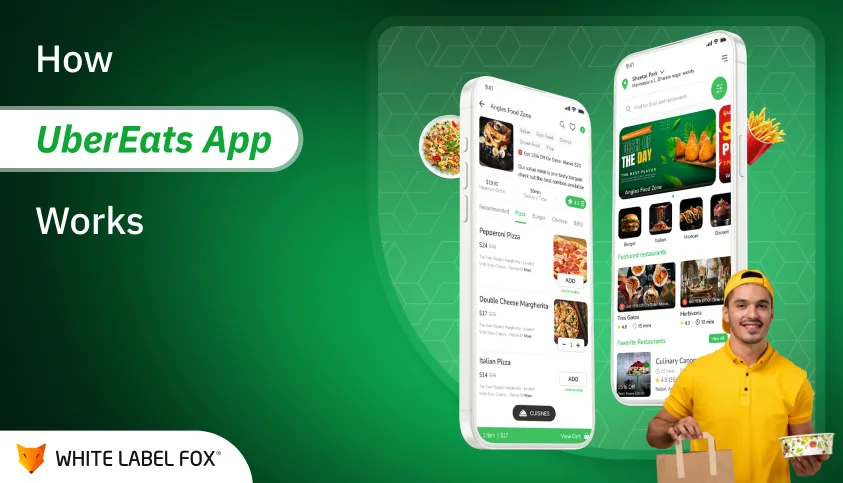
Understanding how does UberEats work requires looking at the journey from the moment a customer opens the app to the moment food lands at their door.
Step 1 - Customer Browses and Orders
The customer opens the UberEats app, enters their delivery location, and browses nearby restaurant menus. Once they select items and pay, the order is placed instantly.
Step 2 - Restaurant Receives the Order
The restaurant gets a notification through their UberEats Tablet or POS integration. They confirm the order and begin preparation.
Step 3 - Delivery Partner Is Assigned
UberEats' algorithm assigns the nearest available delivery partner based on distance, availability, and estimated prep time. The driver picks up the order and heads to the customer.
Step 4 - Real-Time Tracking
The customer tracks the order in real time - from order confirmation, food preparation, driver pickup, to final delivery at the door.
Step 5 - Delivery and Rating
Once delivered, both the customer and restaurant can rate the experience. This feedback loop drives quality control across the entire food delivery platform.
UberEats Business Model: The Three-Sided Marketplace
The UberEats business model operates as a platform economy. Unlike traditional food delivery where a restaurant hires delivery staff, UberEats aggregates supply (restaurants) and demand (customers) through technology - while a third-party gig workforce handles logistics.
| Stakeholder | Role | Value Received |
|---|---|---|
| Customers | Place food orders via app | Convenience, speed, variety |
| Restaurants | List menus, receive orders | Access to a larger customer base |
| Delivery Partners | Pick up and deliver orders | Flexible income |
| UberEats (Platform) | Technology + Matching | Commission + Fees |
This model is asset-light, meaning UberEats doesn't own kitchens, delivery vehicles, or restaurants. The platform's value is entirely in the algorithm, user experience, and network effects.
UberEats Revenue Model: How Does Food Delivery App Make Money?
This is the question most entrepreneurs and investors ask first. How does food delivery app make money - and how does UberEats specifically turn food transactions into a multi-billion dollar revenue engine?
Here is the complete UberEats revenue model broken down:
1. Commission from Restaurants (Primary Revenue Stream)
The UberEats commission model charges restaurants a percentage of each order value. This typically ranges from 15% to 30% depending on the service tier, exclusivity agreement, and promotional visibility the restaurant opts into.
| Service Tier | Commission Range | Features Included |
|---|---|---|
| Basic Listing | 15% – 20% | Standard visibility, order management |
| Plus Plan | 25% – 30% | Better placement, promotional access |
| Premium/Exclusive | Custom | Priority placement, marketing support |
This is the single largest revenue contributor in the UberEats business model and the most debated - many restaurant owners have publicly pushed back on these margins, which is why white label food delivery solutions have gained traction as alternatives.
2. Delivery Fees from Customers
UberEats charges customers a delivery fee per order, typically ranging from $0.99 to $7.99, dynamically calculated based on distance, demand, weather, and time of day. Surge pricing is applied during peak hours - a tactic borrowed directly from Uber's ride-hailing model.
3. Service Fees
Beyond delivery fees, UberEats charges customers a small service fee (usually 5%–15% of the subtotal) which covers platform operational costs, payment processing, and app infrastructure.
4. UberEats Pass / Subscription Model
UberEats One is a subscription plan offering customers unlimited free deliveries on eligible orders for a flat monthly fee. This is a high-margin, recurring revenue stream that also increases order frequency and customer lifetime value.
| Plan | Monthly Fee | Benefit |
|---|---|---|
| UberEats One (US) | ~$9.99/month | $0 delivery on orders $15+ |
| Uber One (Bundle) | ~$9.99–$19.99/month | Discounts on both rides and food |
5. Advertising and Sponsored Listings
Restaurants pay for premium placement in search results, banner ads, and featured categories. This segment - often called Restaurant Ads or Sponsored Listings - is a fast-growing revenue line as the platform matures, mirroring what Amazon did with seller advertising.
6. Virtual Restaurant / Cloud Kitchen Partnerships
UberEats has expanded into white label food delivery solutions for cloud kitchens - delivery-only restaurant concepts with no physical dining space. These operations pay UberEats for access to its delivery infrastructure, boosting GMV (Gross Merchandise Value) without adding restaurant inventory costs.
Core Features of the UberEats Platform
Understanding UberEats app features for restaurants and customers is critical for anyone building a competitive food ordering app development project. Here is a feature-by-feature breakdown:
Customer-Facing Features
| Feature | Description |
|---|---|
| Smart Search & Filters | AI-powered search with filters for cuisine, dietary restrictions, price range, and delivery time |
| Real-Time GPS Tracking | Live order tracking from restaurant prep to doorstep delivery |
| Scheduled Delivery | Pre-schedule orders up to 24 hours in advance |
| Contactless Delivery | Safety-first delivery option with drop-off instructions |
| In-App Chat | Direct communication between customer and delivery partner |
| Ratings & Reviews | Post-delivery feedback loop for quality assurance |
| UberEats Pass | Subscription-based unlimited free deliveries on eligible orders |
| Multiple Payment Options | Credit/debit, UberCash, PayPal, Apple Pay, Google Pay |
UberEats App Features for Restaurants
Order Management Dashboard - A dedicated merchant interface that gives restaurant partners real-time visibility into incoming orders, preparation timelines, and cancellation controls. It integrates with existing POS systems to reduce operational friction for high-volume establishments.
Menu Management Tool - Restaurants can update item availability, pricing, descriptions, and images in real time directly from the app or web dashboard. This ensures customers always see accurate menus without requiring technical knowledge from the restaurant side.
Analytics and Reporting - Detailed performance reports showing order volumes, peak hours, customer ratings, and revenue trends. This data helps restaurants optimize their menus and staffing for maximum profitability within the UberEats ecosystem.
Promotional Tools - Restaurants can create custom discounts, free delivery offers, combo deals, and flash sales directly through the platform. These promotions are visible in search results and push notifications, driving incremental order volume for participating partners.
UberEats Manager App - A mobile-first management app allowing restaurant owners to manage their entire UberEats presence from a smartphone. Everything from menu edits to payouts and customer reviews is accessible in a single dashboard.
Delivery Partner Features
Driver App with Navigation - The delivery partner app integrates turn-by-step navigation, order details, and real-time communication tools. Earnings tracking is built in, showing daily totals, bonuses, and trip history in a clean, easy-to-read interface.
Earnings Dashboard - Delivery partners can view their hourly earnings, incentive bonuses, and weekly payouts in real time. Boost pricing alerts notify drivers when demand surges in specific zones, helping them maximize income during peak windows.
Flexible Scheduling - Unlike traditional employment, delivery partners set their own hours through the app. This gig-model flexibility is a core appeal of the platform and a significant driver of supply-side growth in new markets.
UberEats vs DoorDash vs Zomato: Platform Comparison
The UberEats vs DoorDash vs Zomato comparison is one the most Googled topics in the food tech space. Here is an honest, data-driven look:
| Criteria | UberEats | DoorDash | Zomato |
|---|---|---|---|
| Primary Market | Global (US, UK, CA, AU, etc.) | North America | India, UAE, others |
| Commission Rate | 15%–30% | 15%–30% | 15%–25% |
| Subscription Plan | UberEats One | DashPass | Zomato Gold |
| Delivery Time (avg) | 25–35 mins | 25–40 mins | 30–45 mins |
| Revenue (2023) | ~$12B | ~$8.6B | ~$350M+ |
| Market Differentiator | Ride + Food bundle | Market share dominance (US) | Restaurant discovery + dining |
| White Label Availability | No | No | No |
One insight stands out clearly from this comparison: all three platforms follow the same fundamental on demand food delivery business model. The differences are in execution, market focus, and product strategy - not in the underlying architecture.
This is exactly why ubereats clone app development is one of the most in-demand services in the on demand app development platform category today.
What Makes the UberEats Business Model Scalable?
The food delivery platform business model has proven itself scalable across different geographies and demographics for a few core reasons:
Network Effects at Scale - More restaurants attract more customers. More customers attract more restaurants. More orders attract more delivery partners. This self-reinforcing cycle drives down costs per transaction as the platform grows.
Asset-Light Infrastructure - UberEats does not own vehicles, kitchens, or properties. It owns software, data, and brand - the three most scalable assets in a digital economy.
Data as a Competitive Moat - UberEats has billions of data points on customer preferences, restaurant performance, and delivery patterns. This proprietary data powers recommendations, surge pricing, and supply optimization - capabilities that no new entrant can replicate quickly.
Cross-Product Bundling - The Uber One bundle combines rides and food delivery, increasing retention and customer lifetime value in ways that DoorDash and Zomato cannot match in their current form.
Challenges in the Food Delivery Platform Business Model
No honest analysis of the UberEats business model is complete without acknowledging the real challenges:
- Profitability at Scale Is Hard - UberEats and most delivery platforms still operate at thin or negative margins after driver pay, marketing, and infrastructure costs.
- Restaurant Margin Pressure - High commission rates have driven restaurants to explore direct ordering apps and white label food delivery solutions.
- Driver Retention - Gig worker churn is a persistent operational challenge, especially in competitive markets.
- Regulatory Risk - Gig economy classifications and food safety regulations vary significantly by country, creating legal and compliance complexity.
These pain points are precisely why the market for UberEats clone app development and custom on demand app development platform solutions is growing rapidly among startups and SMBs.
Want to Build Your Own Food Delivery Platform?
If the UberEats business model has validated the opportunity for you, the question becomes: how do you build a similar platform without spending years and millions of dollars?
This is where White Label Fox comes in.
We have spent 9+ years building and deploying on demand app development solutions for startups, enterprises, and entrepreneurs globally. Our UberEats clone app is a fully customizable, white label food delivery solution that includes:
- Multi-restaurant ordering platform with real-time tracking
- Customer app, restaurant dashboard, and driver app - all three panels included
- Commission management and payout automation
- AI-powered recommendations and smart search
- Complete cloud & DevOps infrastructure setup
- Mobile app development for both iOS and Android
- Scalable architecture built for growth
Whether you want a direct UberEats clone, a Zomato-style restaurant discovery app, or a fully custom food ordering app development project, we build it - branded to your business, ready to launch.
Conclusion: The UberEats Model Is Proven - Now It Is Your Turn
The UberEats business model is not a secret. It is a well-documented, battle-tested framework for capturing value in the food delivery ecosystem - through commissions, fees, subscriptions, and advertising. The real competitive edge comes from execution: better UX, faster delivery, stronger restaurant relationships, and smarter data use.
For entrepreneurs, the insight from the food delivery platform business model is clear: you do not need to reinvent the wheel. You need to enter your market with the right product, the right pricing, and the right technology partner behind you.
White Label Fox has helped businesses across 5+ continents launch on demand food delivery apps, ride-hailing clones, and multi-service super apps - all built on a scalable, production-ready on demand app development platform.
Frequently Ask Questions

Deep Faldu - CTO
Author
As the Chief Technology Officer, Deep Faldu spearheads innovation at White Label Fox, ensuring seamless, scalable, and high-performance app solutions. His technical expertise, problem-solving skills, and commitment to excellence help businesses thrive in the competitive digital landscape. He continuously explores new technologies to enhance product efficiency and user experience.