Quick Answer: How Much Does an InDriver Clone App Cost?
An InDriver clone app costs between $3,000 and $120,000+ in 2027. The final price depends on your development approach, feature list, platforms, and team location.
- Ready-made (white-label) indriver clone: $3,000 to $12,000
- MVP custom build: $15,000 to $30,000
- Mid-level custom app: $30,000 to $60,000
- Advanced, enterprise-grade app: $60,000 to $120,000+
Most startups launch with a ready-made or MVP solution first. Then they add features as the user base grows.
Key Takeaways
- An indriver clone lets riders name their own fare, and drivers accept or counter it.
- Ready-made solutions cost less and launch in 2 to 4 weeks.
- Custom builds cost more but give you full control over code, design, and features.
- Three apps are needed: rider app, driver app, and admin panel.
- Maintenance costs 15% to 20% of the build cost every year.
- Choosing the right region and team can cut your budget by 40% or more.
Launch Your InDrive Taxi App Faster
Skip months of development. Start with our ready-made indriver clone and customize it to fit your brand, city, and budget.
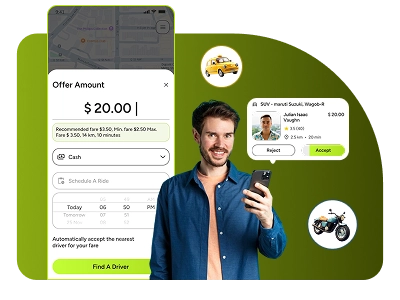
What Is an InDriver Clone App?
An indriver clone is a ready-to-launch taxi booking app that copies the core business model of inDrive (formerly inDriver). The original platform started in 2013 and now operates in many countries across Asia, Africa, Latin America, and beyond.
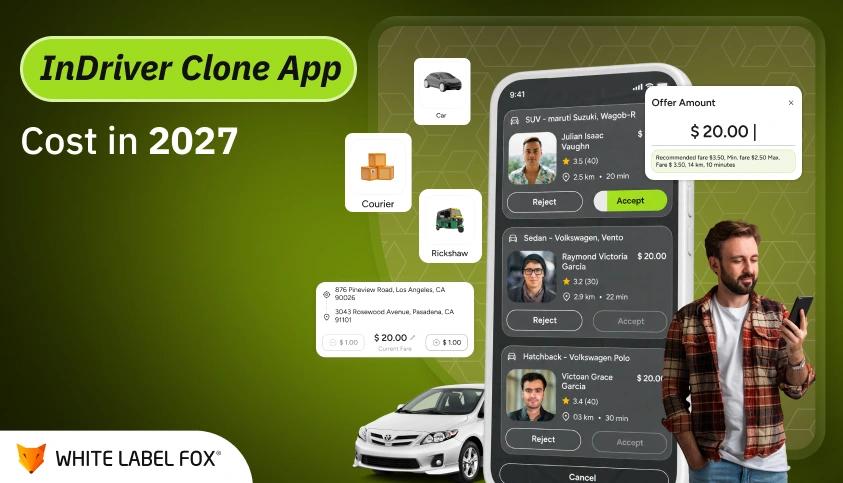
The model is simple. A rider posts a trip request and suggests a price. Nearby drivers see the offer. They accept it, or they send a counter offer. The rider then picks the driver they like best.
This fare negotiation model is what makes the indrive taxi app different from Uber or Lyft, where the platform sets the price. Riders get control, and drivers get fair earnings.
An indrive clone gives you the same core idea. You can brand it, change the features, and launch it in your own city or country.
Why Entrepreneurs Are Building InDriver Clone Apps in 2027
The on-demand ride market keeps growing. Smartphone use is rising, especially in emerging markets. People want affordable and flexible rides, and many do not trust fixed surge pricing.
Here is why the indriver clone app model attracts founders:
- Lower commission: Drivers pay a smaller fee than on many big platforms, so more drivers join.
- Price control: Riders feel respected because they set the offer.
- Local fit: Cities with price-sensitive users respond well to negotiation.
- Low entry barrier: A white-label solution lets you test the market fast.
- Multiple revenue streams: You can earn from commissions, subscriptions, ads, and delivery services.
If you plan to enter the taxi booking space, this model offers a smart and proven starting point.
How Does an InDriver Clone App Work?
The process has six simple steps:
- Rider requests a trip. The rider enters pickup and drop-off points, then adds a fare offer.
- Nearby drivers get an alert. The request shows the route, distance, and offered price.
- Drivers respond. They accept the price or send a counter offer.
- Rider chooses a driver. The rider checks the driver’s rating, car, and price.
- Trip starts. Both sides track the ride live on GPS.
- Payment and rating. The rider pays by cash, card, or wallet. Both sides leave feedback.
The admin panel manages everything behind the scenes, including users, drivers, payments, and reports.
Core Features of an InDriver Clone App
Features drive cost. The more features you add, the higher your budget goes. Here are the main modules.
Rider App Features
- Easy sign-up with phone number, email, or social login
- Fare offer and bidding option
- Real-time driver tracking
- Multiple payment methods
- Ride history and receipts
- In-app chat and call
- SOS and emergency button
- Driver ratings and reviews
- Scheduled rides
- Promo codes and referral rewards
Driver App Features
- Driver registration with document upload
- Online and offline toggle
- Ride request feed with fare details
- Counter offer option
- Turn-by-turn navigation
- Earnings dashboard
- Trip history
- Rider rating system
- Instant or weekly payout options
Admin Panel Features
- Dashboard with live analytics
- Driver and rider management
- Document verification
- Commission and pricing settings
- Payment and payout control
- Promo and notification management
- Complaint handling
- Reports and data export
Advanced Features to Consider
- AI-based fare suggestions
- Multi-city and multi-language support
- Intercity rides
- Parcel and courier delivery
- Driver subscription plans
- Corporate accounts
- Women-only ride option
- Ride sharing and carpooling
InDriver Clone App Cost Breakdown in 2027
Let us look at where your money goes.
1. Cost by Development Approach
Your approach is the biggest cost factor.
- White-label or ready-made script: $3,000 to $12,000. The code already exists. The vendor adds your logo, colors, and basic settings.
- Hybrid (ready-made plus customization): $10,000 to $30,000. You start with a base product and add your own features.
- Fully custom development: $30,000 to $120,000+. A team builds the app from scratch.
2. Cost by App Complexity
- Basic MVP ($15,000 to $30,000): Core booking, bidding, GPS, payments, and a simple admin panel. Launch time: 3 to 4 months.
- Mid-level app ($30,000 to $60,000): MVP features plus in-app chat, promo codes, multiple payment gateways, and analytics. Launch time: 4 to 6 months.
- Advanced app ($60,000 to $120,000+): AI features, multi-city support, delivery services, and custom integrations. Launch time: 6 to 9 months.
3. Cost by Component
Here is a rough split for a mid-level project:
- UI/UX design: $2,000 to $6,000
- Rider app (Android and iOS): $8,000 to $18,000
- Driver app (Android and iOS): $8,000 to $18,000
- Admin panel: $4,000 to $10,000
- Backend and APIs: $6,000 to $14,000
- Third-party integrations (maps, SMS, payments): $2,000 to $6,000
- Testing and QA: $2,000 to $5,000
4. Cost by Team Location
Developer rates differ by region. Typical hourly rates in 2027 look like this:
- North America: $80 to $150 per hour
- Western Europe: $60 to $120 per hour
- Eastern Europe: $35 to $70 per hour
- India and South Asia: $20 to $45 per hour
Many startups choose South Asian or Eastern European teams. They get strong quality at a lower price.
5. Cost by Platform
- Android only: Lowest cost
- iOS only: Slightly higher than Android
- Android and iOS (native): Highest cost
- Cross-platform (Flutter or React Native): Saves 25% to 35% compared with two native apps
Comparison Table: Ready-Made vs Hybrid vs Custom InDriver Clone
Use this table to pick the right path for your business.
| Factor | Ready-Made (White-Label) | Hybrid (Ready-Made + Custom) | Fully Custom Build |
|---|---|---|---|
| Estimated Cost | $3,000 – $12,000 | $10,000 – $30,000 | $30,000 – $120,000+ |
| Launch Time | 2 – 4 weeks | 6 – 12 weeks | 4 – 9 months |
| Customization | Limited (branding, basic settings) | Moderate to high | Unlimited |
| Source Code Ownership | Usually yes, with a license | Yes | Yes, full ownership |
| Best For | Startups testing a city or niche | Growing businesses needing unique features | Large companies with a long-term product vision |
| Risk Level | Low | Medium | High |
| Scalability | Good with upgrades | Very good | Excellent |
| Maintenance Effort | Low | Medium | High |
Bottom line: Start with a ready-made or hybrid indrive clone if you want to enter the market quickly and keep risk low. Choose a custom build only when you have a clear budget and a unique product vision.
InDriver Clone vs Traditional Uber-Style Taxi App
Many founders ask which model fits them better. Both apps book rides, but they work in different ways.
An Uber clone app sets the fare for the rider. The platform uses distance, time, and demand to calculate the price. This model gives riders a clear quote, but prices can jump during peak hours.
An indrive taxi app flips this idea. The rider proposes the price, and drivers respond. This model builds trust in cities where people compare every rupee, peso, or dollar. It also gives drivers the power to reject low offers.
From a cost view, the two models are close. The bidding module and the counter offer flow add some development effort to an indriver clone. However, you can skip complex surge pricing logic. Many teams find that these two costs balance out.
If your target market is price-sensitive, choose the indrive clone model. If your market expects fixed upfront pricing, a classic taxi booking model may fit better. You can also offer both options inside one app.
Hidden Costs You Should Plan For
Many founders only budget for development. Other costs show up after launch, so plan for them early.
- Third-party services: Google Maps API, SMS and OTP gateways, push notifications, and payment gateway fees.
- Cloud hosting: $100 to $1,500 per month, based on traffic.
- App store fees: Google Play charges a one-time $25. Apple charges $99 per year.
- Legal and licensing: Taxi operator permits, insurance, terms of service, and privacy policy.
- Marketing and driver onboarding: Often 20% to 40% of your first-year budget.
- Customer support: A small team or outsourced help desk.
- Maintenance and updates: About 15% to 20% of the build cost every year.
A good rule: keep 25% of your total budget for post-launch activity.
How Long Does It Take to Build an InDriver Clone App?
Timelines depend on your approach:
- Ready-made solution: 2 to 4 weeks
- Hybrid solution: 6 to 12 weeks
- Custom MVP: 3 to 4 months
- Full-featured custom app: 6 to 9 months
A typical custom project moves through five stages: discovery, design, development, testing, and launch. Fast decisions from your side shorten the timeline.
How InDriver Clone Apps Make Money
Cost matters, but so does revenue. Your indriver clone app can earn through several channels:
- Commission per ride: Charge drivers a small percentage, often 5% to 15%.
- Driver subscriptions: Drivers pay a flat weekly or monthly fee instead of commission.
- In-app advertising: Local brands pay to reach your riders.
- Delivery and courier services: Add parcel delivery to the same app.
- Premium rides: Offer higher-priced options such as luxury cars or women-only rides.
- Cancellation fees: Charge a fee when riders or drivers cancel late.
Most businesses reach break-even within 12 to 24 months. Strong local marketing speeds this up.
Tips to Reduce Your InDriver Clone App Cost
You can cut costs without hurting quality. Try these steps:
- Launch an MVP app first. Build only the core features, then add more after you collect user feedback.
- Pick cross-platform technology. Flutter and React Native save time and money.
- Start with one city. Prove the model locally before you expand.
- Use a white-label base. Customize it instead of building from zero.
- Choose the right outsourcing region. Compare rates, but also check reviews and portfolios.
- Define scope clearly. Changing requirements mid-project adds cost.
- Reuse proven third-party tools. Do not rebuild maps, chat, or payments.
How to Choose the Right Development Partner
Your partner decides the quality of your product. Check these points before you sign:
- Portfolio: Have they built taxi booking or on-demand apps before?
- Source code: Will you own the full code?
- Support: Do they offer post-launch bug fixes and updates?
- Transparency: Do they share a detailed cost sheet and timeline?
- Security: Do they follow data protection and secure payment standards?
- Reviews: Read client feedback on trusted platforms such as Clutch or GoodFirms.
- Demo: Ask for a live demo of the rider, driver, and admin apps.
Legal and Compliance Checklist
Taxi services face rules that vary by country and city. Before launch, check:
- Local transport and taxi licensing laws
- Driver background check requirements
- Vehicle insurance rules
- Data privacy laws, such as GDPR or local equivalents
- Tax and invoicing rules
- Fare cap rules, since some cities limit negotiated pricing
Talk to a local legal expert. This step protects your business from fines later.
Trends Shaping Taxi Booking Apps in 2027
- AI pricing suggestions: Smart tools suggest fair offers to riders and drivers.
- Electric vehicle options: More riders want green rides.
- Safety-first features: Live trip sharing, ride PIN, and audio recording are becoming standard.
- Super app model: Taxi, delivery, and payments in one app.
- Local payment methods: Wallets and UPI-style instant payments grow fast.
- Voice and chat booking: Riders book through assistants and messaging apps.
Building these trends into your roadmap keeps your app competitive.
Conclusion
An indriver clone is one of the smartest ways to enter the taxi booking market in 2027. The model is proven, riders like it, and drivers prefer its fair earnings. The cost depends on your approach. A ready-made solution starts around $3,000. A fully custom app can pass $100,000.
For most founders, the best path is simple. Start with a ready-made or hybrid indrive clone, test one city, collect feedback, and then scale. This approach protects your budget and speeds up your time to market.
Pick your development partner with care. Look for a team with real taxi app experience, full source code ownership, and strong after-launch support.
Ready to launch your own taxi booking app? Talk to the WhiteLabelFox team today. Get a free consultation and a clear cost estimate for your indriver clone app.
Frequently Asked Questions

Deep Faldu - CTO
Author
As the Chief Technology Officer, Deep Faldu spearheads innovation at White Label Fox, ensuring seamless, scalable, and high-performance app solutions. His technical expertise, problem-solving skills, and commitment to excellence help businesses thrive in the competitive digital landscape. He continuously explores new technologies to enhance product efficiency and user experience.