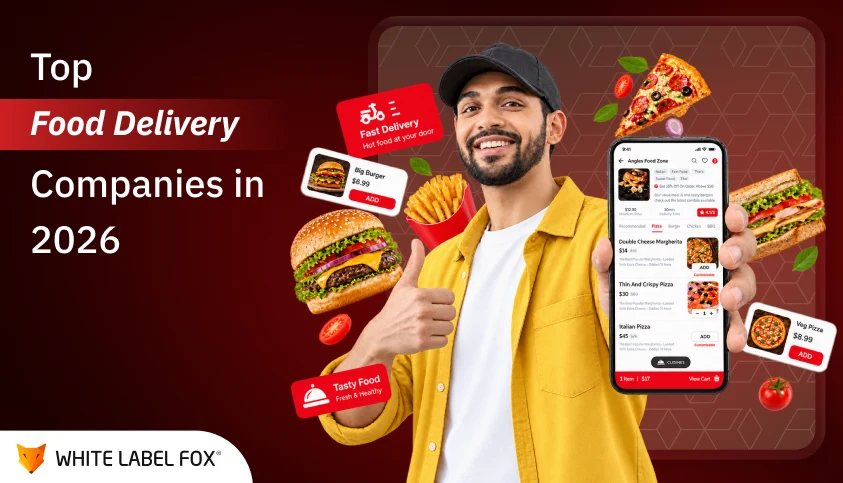
Food delivery companies now do much more than bring hot meals to your door. They deliver groceries, run ad businesses and sell memberships.
The last two years reshaped the industry. DoorDash bought Deliveroo and Wonder took over Grubhub. Prosus bought Just Eat Takeaway, and Uber has offered $14.8 billion for Delivery Hero.
This guide covers the top food delivery companies in 2026. You get current numbers, ownership changes and what each player is betting on next. It also helps on demand delivery startups see who is winning and why.
Food Delivery in 2026: Quick Snapshot
- DoorDash handled 970 million orders in Q2 2026, up 27% year on year.
- DoorDash held 60.7% of US food delivery sales at the end of 2024 (Earnest Analytics data); Uber Eats held 26.1%.
- Uber agreed on 16 July 2026 to acquire Delivery Hero for a $14.8 billion equity value.
- In India, Eternal (Zomato) holds over 58% of food delivery GOV as of Q1 FY27.
Ready to Launch Your Own Food Delivery App?
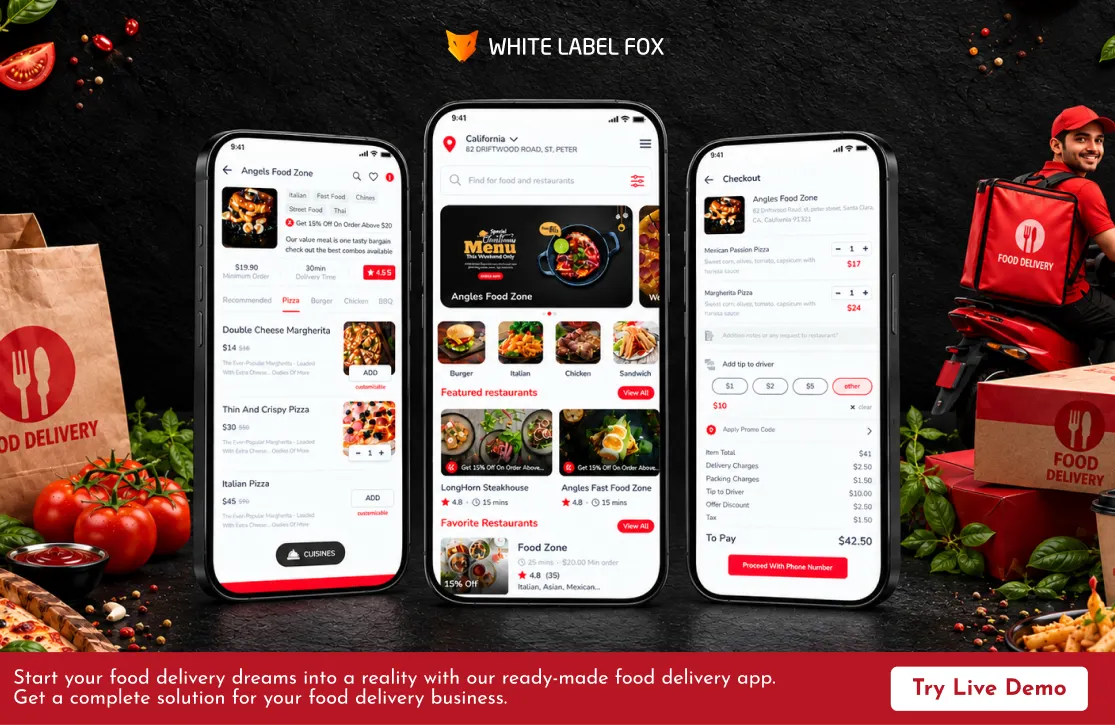
Get a white-label food delivery solution with customer, restaurant and driver apps plus an admin panel. Launch under your brand in weeks, not months.
Food Delivery Market Size in 2026
Every research firm defines "food delivery" differently. Some count only restaurant meals, others add grocery.
That is why 2026 estimates range from under $300 billion to over $1.5 trillion. Here is how the main sources compare.
| Source | 2026 estimate | Forecast | CAGR | Scope |
|---|---|---|---|---|
| Grand View Research | $355.6B | $505.5B by 2030 | 9.4% | Online food delivery |
| Mordor Intelligence | $284.7B | $468.5B by 2031 | 10.47% | Online food delivery |
| Statista | $1.51T | $2.05T by 2031 | 6.24% | Meals plus grocery |
Market size matters most to meal delivery startups deciding where to enter. The estimates above vary by scope, so always check whether grocery is included before comparing.
What Changed Since 2023: Major Deals
Consolidation is the biggest story in the industry. Fewer, larger players now control most of the orders.
| Date | Deal | Why it matters |
|---|---|---|
| Jan 2025 | Wonder completes Grubhub purchase ($650M) | Grubhub falls from a $7.3B deal in 2021 to a small US player. |
| Oct 2025 | Prosus completes Just Eat Takeaway.com acquisition (EUR 4.1B) | A European delivery leader gets a new owner focused on profitability. |
| 2 Oct 2025 | DoorDash completes Deliveroo acquisition (~$3.7B) | DoorDash adds Deliveroo to Wolt and becomes a major European player. |
| Sept 2025 | Meituan launches Keeta in the UAE | A Chinese giant challenges Talabat, Careem and Deliveroo in the Gulf. |
| 16 Jul 2026 | Uber offers $14.8B for Delivery Hero | Would take Uber delivery to 99 markets. Close expected H2 2027. |
Big platforms are buying each other. For delivery service startups, that leaves local and niche markets less crowded.
Biggest Food Delivery Companies in 2026 at a Glance
Here is a comparison of the top food delivery companies in 2026 by owner, markets, headline number and main competitors.
| Company | Owner / status in 2026 | Main markets | 2026 headline | Main competitors |
|---|---|---|---|---|
| DoorDash | Public (DASH) | US, Canada, Australia, Europe (Wolt, Deliveroo) | 970M orders in Q2 2026 | Uber Eats, Grubhub |
| Uber Eats | Part of Uber (NYSE: UBER) | North America, Europe, Asia-Pacific, LatAm | $27.5B Delivery bookings in Q2 2026 | DoorDash, Grubhub |
| Meituan (Keeta) | Meituan | China, Hong Kong, Saudi Arabia, UAE, Qatar | Saudi profitable since July 2026 | Talabat, Careem, Deliveroo |
| Delivery Hero | Uber offer pending | 50 markets in Uber scope | About $42B gross bookings in 2025 | Uber Eats, Keeta |
| Just Eat Takeaway.com | Owned by Prosus | UK, Germany, Netherlands and more | Grubhub sold, focus on Europe | Deliveroo, Uber Eats |
| Deliveroo | Owned by DoorDash | UK, Europe, Middle East | Growth accelerated in Q2 2026 | Just Eat Takeaway.com, Uber Eats |
| Zomato (Eternal) | Public (Eternal Ltd) | India and select markets | 58%+ India food delivery GOV share | Swiggy |
| Swiggy | Public | India | Instamart GOV up 40% in Q1 FY27 | Zomato |
| Grubhub | Owned by Wonder | US | About 6% US share (end 2024) | DoorDash, Uber Eats |
| Gopuff | Private | US, UK | Reported $8.5B valuation (Nov 2025) | DoorDash, Uber Eats |
| Talabat | Delivery Hero brand | Gulf region | Faces Keeta competition | Keeta, Careem, Deliveroo |
Profiles of the Top Food Delivery Companies
1. DoorDash
DoorDash is the clear leader in US food delivery. It has grown beyond restaurants into grocery, retail and international markets.
- Founded 2013, San Francisco. Founders: Tony Xu, Stanley Tang, Andy Fang, Evan Moore.
- Q2 2026: 970M orders, $33.1B Marketplace GOV, $4.5B revenue (DoorDash results).
- Owns Wolt and Deliveroo. 35M+ members across DashPass, Wolt+ and Deliveroo Plus.
DoorDash holds about 60% of US food delivery sales. It grew by adding grocery, retail and memberships. Many startups study this model first. A DoorDash clone app shows how the customer, restaurant and driver sides fit together.
2. UberEats
UberEats benefits from Uber's ride-hailing user base. Cross-selling rides and delivery is its main advantage.
- Launched 2014. Uber Delivery gross bookings about $27.5B in Q2 2026.
- Uber One hit 50M members in Q1 2026; members drive about half of Mobility and Delivery bookings.
- Grocery and retail reached about $15B annualised gross bookings, growing roughly 40% YoY.
- Top Uber Eats competitors: DoorDash in the US, Delivery Hero in Europe and Asia, and Keeta in the Gulf.
Uber Eats gets a lot of its growth from Uber's existing riders, who can order food from the same account. Founders often review an UberEats clone app first. It shows which features a platform needs on day one, such as live tracking and in-app payments.
3. Meituan (Keeta)
Meituan is China's dominant delivery platform. Its international brand Keeta is now the fastest-moving newcomer outside China.
- Keeta entered Hong Kong in 2023, Saudi Arabia in 2024 and the UAE in Sept 2025.
- Meituan says Saudi operations will be profitable since July 2026. Hong Kong was stable by Aug 2026.
- UAE restaurant delivery orders rose 15.2% in H1 2026.
4. Delivery Hero
Delivery Hero is a Berlin-based group. Its brands span Europe, Asia, the Middle East and Latin America. It is now the target of Uber's biggest acquisition offer.
- Founded 2011, Berlin. Brands include foodora, Glovo, PedidosYa and Talabat.
- Uber offer: EUR 41.50 per share, $14.8B equity value, expected close H2 2027.
- Businesses in 14 overlap markets are planned for sale to SSW Partners (~$1.6B).
5. Just Eat Takeaway.com
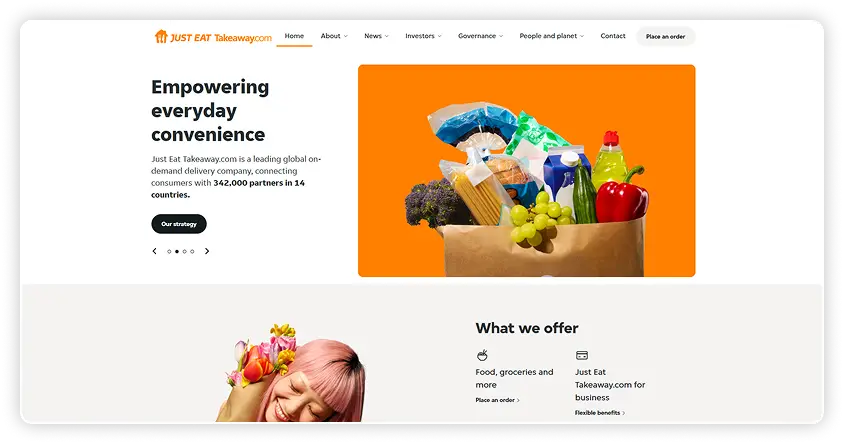
JustEat Takeaway.com now focuses on its strongest European markets. It sold Grubhub to concentrate its capital.
- Formed by the 2020 merger of Just Eat and Takeaway.com.
- Acquired by Prosus in an all-cash deal worth about EUR 4.1B (EUR 20.30 per share).
- Strongest in the UK, Germany and the Netherlands.
Just Eat Takeaway.com runs a simple marketplace. Restaurants list their menus, and customers order through one app. Teams planning a local version often study a Just Eat clone app. It shows how the ordering flow and restaurant panel work.
6. Zomato (Eternal)
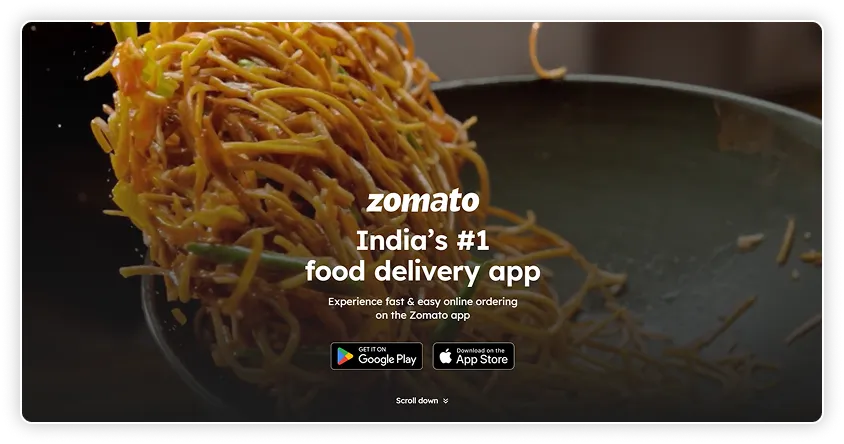
Zomato is India's food delivery leader. Its parent company is now called Eternal.
- Eternal runs Zomato, Blinkit (quick commerce), Hyperpure and District.
- Holds over 58% of India food delivery GOV in Q1 FY27
- Blinkit: NOV Rs 17,132 cr in Q1 FY27 (+86% YoY), 2,443 stores in 300+ cities.
Zomato began as a restaurant discovery site. It added delivery, and now sits alongside Blinkit under Eternal. Want reviews and ordering in one place? A Zomato clone app built on an online food ordering app shows how those pieces connect.
7. Swiggy
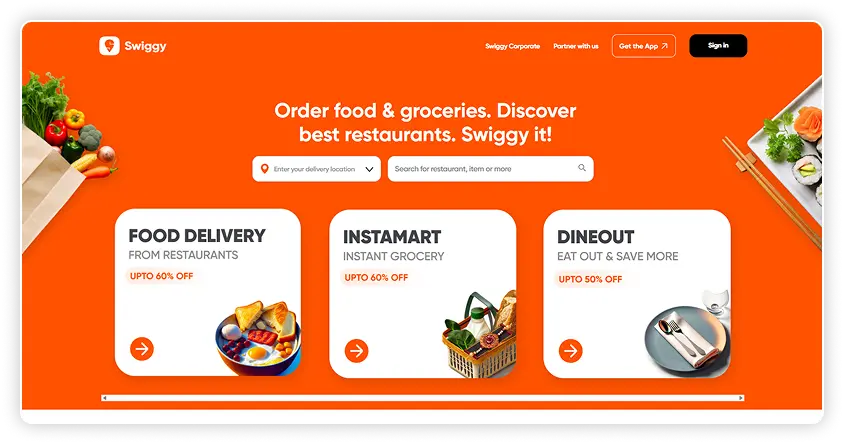
Swiggy is India's number two in food delivery. It is betting heavily on Instamart for quick commerce.
- Instamart GOV reached Rs 7,907 cr in Q1 FY27, up 40% YoY.
- Instamart reached contribution break-even but is not yet EBITDA positive.
Instamart shows how delivery players are moving into groceries. Planning both services in one app? A Swiggy clone app shows how the two models can share one platform.
8. Grubhub
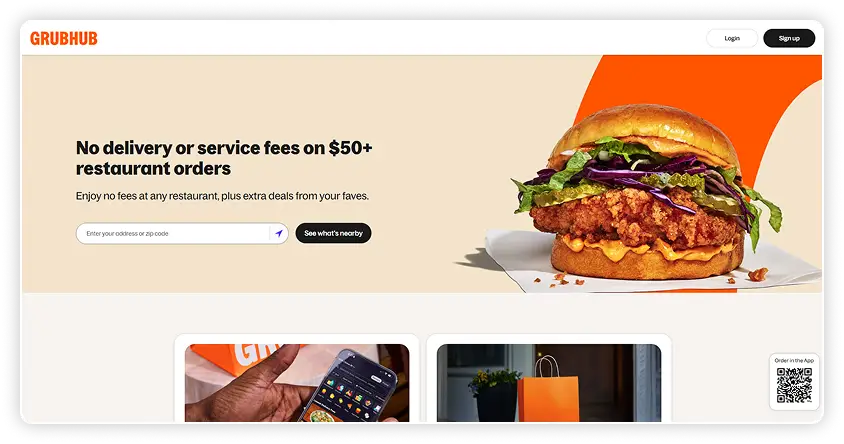
- Sold by Just Eat Takeaway.com to Wonder for $650M (closed Jan 2025).
- About 6.3% of US food delivery sales at the end of 2024.
- Seamless and other legacy brands sit in the same family.
Grubhub was once the biggest name in US delivery. It will be sold to Wonder in 2025. Its story shows that focused local services can still find customers. Some founders use a Grubhub clone as the base for a niche launch.
9. Gopuff
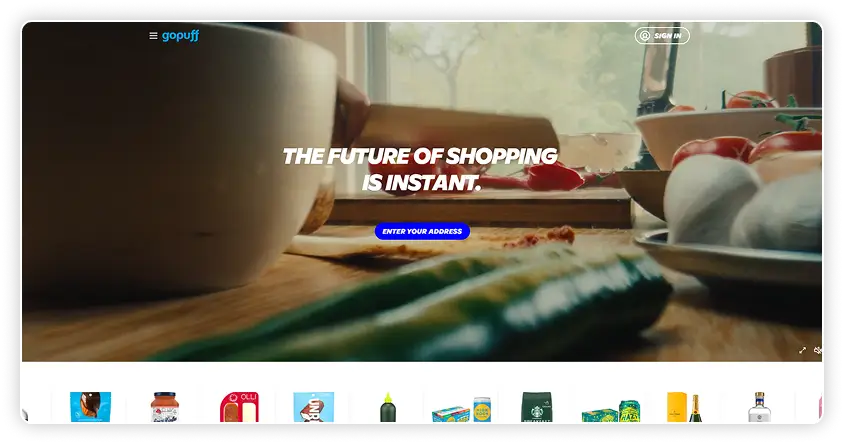
Gopuff began as a convenience delivery service. It now leans into groceries and instant delivery.
- Founded 2013, Philadelphia.
- Reported raising about $250M at an $8.5B valuation in Nov 2025.
10. Talabat
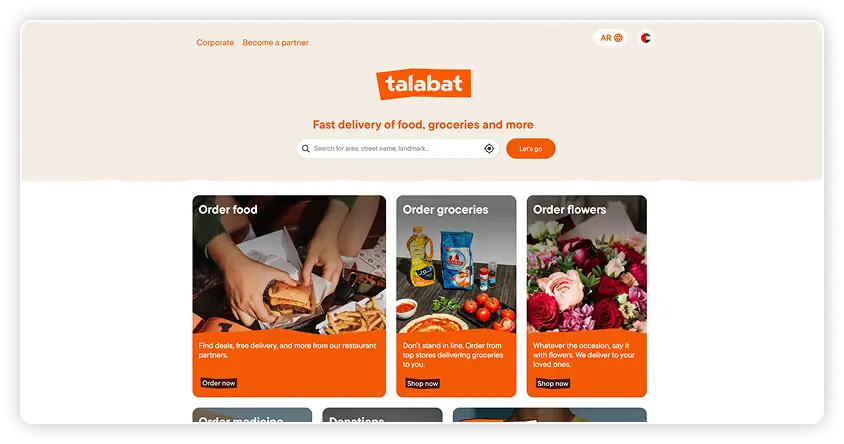
Talabat is one of the best-known delivery brands in the Gulf. It now faces pressure from Keeta and Careem.
- Founded in Kuwait in 2004 and part of Delivery Hero.
- Competes in the UAE, Saudi Arabia, Qatar, Kuwait, Bahrain and more.
Talabat is one of the best-known delivery brands in the Gulf. Language, payment habits and local rules shape the experience there. Founders building for similar markets often study a Talabat clone app. Arabic support and regional payments matter most, so start from an online food ordering system.
US Food Delivery Market Share
The US market is now a DoorDash-led duopoly. Grubhub has fallen far behind.
| Company | Share of US food delivery sales (end 2024) |
|---|---|
| DoorDash | 60.7% |
| Uber Eats | 26.1% |
| Grubhub | 6.3% |
Food Delivery Models and How Food Delivery Companies Make Money
Most platforms mix several food delivery models. These include marketplace commissions, memberships and advertising. Here is how each one earns revenue.
| Model | How it works | Examples |
|---|---|---|
| Marketplace (aggregator) | Lists restaurants and takes a commission on each order. | Just Eat Takeaway.com, Zomato |
| Logistics only | Provides couriers for restaurants that take their own orders. | DoorDash Drive, Uber Direct |
| Full-stack hybrid | Marketplace plus own couriers, memberships and ads. | DoorDash, Uber Eats, Meituan |
| Revenue stream | How it works |
|---|---|
| Commissions | Restaurants pay a percentage of each order. |
| Delivery and service fees | Customers pay per order. DoorDash revenue was about 13.5% of Marketplace GOV in Q2 2026 (our calculation). |
| Memberships | DashPass, Uber One and similar plans trade fees for loyalty. |
| Advertising | Restaurants and brands pay for placement and promotions. |
| Grocery and retail | Fast-growing category with higher baskets. |
| Build-your-own platforms | Operators who launch their own app can use the same streams. See the revenue streams of a white label food ordering app. |
Key Trends for 2026 and 2027
- Consolidation: Uber-Delivery Hero, DoorDash-Deliveroo and Prosus-Just Eat show scale is winning.
- Memberships: Subscriptions now drive a large share of orders.
- Quick commerce: Blinkit and Instamart in India push delivery beyond meals. So does grocery at Uber and DoorDash.
- Chinese expansion: Keeta is building shares in the Gulf and Brazil.
- Automation: DoorDash is building autonomous delivery. Keeta is testing drones in Dubai.
- Profitability: DoorDash posted $914M adjusted EBITDA in Q2 2026. Growth without losses is now the goal.
- Competition: New entrants like Keeta cut prices with subsidies. That makes year one harder for delivery service startups.
- Regulation: Cities such as New York and Seattle cap commissions and set courier pay rules.
Thinking of Starting Your Own Food Delivery Business?
The big platforms are consolidating, but local and niche markets are still open. Many on demand delivery startups launch with a ready-made app. They skip the build from scratch.
Founders of meal delivery startups can pick a model that fits their city. It could be a marketplace, a single-restaurant app or a mix.
A white label online food ordering app gives you your own brand. You get a customer app, a restaurant panel, a driver app and an admin panel.
Want to see how this works? Explore the online food ordering app and its full feature list. You can also compare the DoorDash clone app and UberEats clone app side by side.
Final Thoughts: Where Food Delivery Companies Go Next
The top food delivery companies in 2026 are bigger, fewer and more focused on profit than they were in 2023. Scale, memberships and grocery now decide who wins.
For new operators, the opening is in local and niche markets where the giants are weaker. Start by studying how these companies make money, then pick a model that fits your city.
Frequently Asked Questions

Viral Kacha - CEO & Sales Head
Author
With years of expertise in the on-demand app industry, Viral Kacha leads White Label Fox with a vision to empower startups and enterprises with top-tier, ready-made app solutions. His strategic approach, strong leadership, and deep market understanding drive business growth, innovation, and client success. He is dedicated to helping businesses scale efficiently with cutting-edge technology.