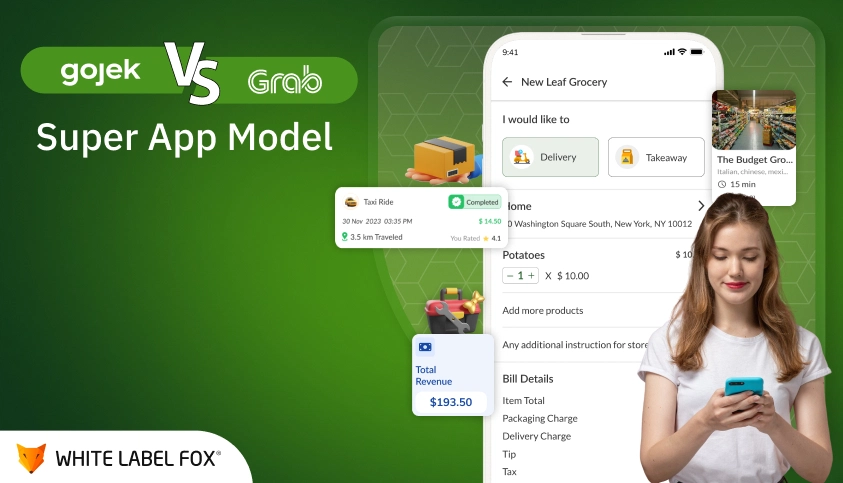
The biggest change to the super app model in 2026 isn't a feature. It's where the profit comes from. Indonesia capped commissions on two-wheeler rides and GoTo reported that fintech out-earned on-demand for the first time.
If you're planning a super app in an emerging market, that shift changes which model you should copy. You're not choosing an app to download. You're choosing a business model to build.
This guide compares the Gojek and Grab models as businesses, using data as of September 2026. You'll get a side-by-side view, a look at what 2026 changed and a decision framework you can apply to your own market.
Gojek vs Grab Super App Model at a Glance
Choose the Gojek Clone App model if you can win one dense market with many services tied together by a wallet. Choose the Grab model if you can win rides or delivery first, then add fintech and expand across borders.
Neither wins everywhere. In 2026, the better pick is the model that adds non-commission revenue faster and survives a commission cap. As of September 2026, both companies are leaning into fintech, so the real difference is sequence, not destination.
| Factor | Gojek model | Grab model |
|---|---|---|
| Starting point | Motorbike-taxi service in Indonesia (2010) | Taxi aggregator in Malaysia (2012) |
| Expansion path | Add services inside one dense market | Rides and delivery first, then fintech, then new countries |
| Core strength | Ecosystem density: one user, many services | Scale in a core service, repeated across markets |
| Revenue engine | Commissions across several services, plus wallet activity | Ride and delivery commissions first, fintech layered on top |
| Fintech role | Wallet ties services together from the start | Second stage that monetizes the existing user base |
| Geographic strategy | Depth in one market first | Breadth across countries (eight in Southeast Asia |
| Best for | Dense markets with many unmet service needs | Founders with fleet or delivery strength and a multi-city plan |
| Main risk | Running several supply sides at once | Heavy early exposure to ride commissions and multi-country rules |
See the Super App Model in Action
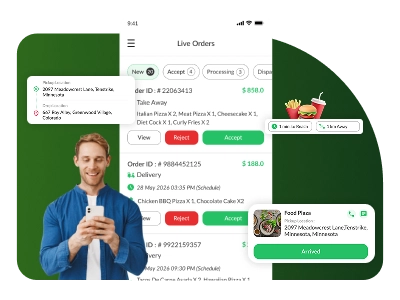
Explore a working Gojek-style super app before you commit. Walk through the user, provider and admin flows and judge the model yourself.
The Gojek Model Explained: Ecosystem First
Gojek started in 2010 as an Indonesian motorbike-taxi service. In May 2021, it merged with Tokopedia to form GoTo, a group that spans on-demand services and fintech.
The model works like this: you build many services in one dense market and connect them with a wallet. A rider who pays from the wallet is one tap away from ordering food. A food customer with a balance is one tap away from booking a ride. Each service raises the frequency of the others, and the wallet keeps money inside the ecosystem. Users who try several services are harder to lose than users who only take rides.
That's why we call it ecosystem-first. Growth comes from depth per user, not only from adding users. It's the same logic we used in our Careem Clone vs Gojek Clone comparison, where Gojek is the ecosystem-first model and Careem is the mobility-first one.
To make this model work, you need three things:
- Density. Enough users and providers in one area that every service has reliable supply.
- A wallet people use daily. Without it, the services stay separate apps under one logo.
- Operational range. You'll manage several supply sides at once, such as drivers, merchants and service providers.
A Gojek clone app packages this model into one platform. If you want to see how the user, provider and admin flows connect, read how a Gojek clone app works. We won't repeat the revenue basics here. Our guide to clone app monetization and revenue models covers them.
The Grab Model Explained: Mobility and Delivery First
Grab started in 2012 as a Malaysian taxi aggregator. It's headquartered in Singapore and, as of September 2026, operates in eight Southeast Asian countries.
The Grab model follows a sequence. You win mobility and delivery first. You add fintech on top. Then you expand across countries and repeat the playbook.
Rides and delivery create daily habits and a large base of users and partners. Fintech then monetizes that base through payments and financial products. Each new country reuses the same core.
That's why it's mobility- and delivery-first. The core service is the entry point, and the rest of the app grows around it.
To make this model work, you need:
- A strong core service. Fast pickups, reliable couriers and predictable pricing come before any extra feature.
- Fleet and delivery operations. You'll manage supply across several cities, not just one.
- Regulatory and partner capacity. Fintech and multi-country growth both bring licensing, compliance and local partners.
If you plan to launch this way, a Grab clone gives you the rides-and-delivery base to build on. The model isn't a lesser version of Gojek's. It's a different order of operations.
The trade-off is focus. You'll spend your first months perfecting one service instead of launching many. That discipline is the strength of this model: you learn your unit economics on a single product before you add new ones. It's also the risk, because early revenue leans on ride and delivery commissions until fintech is ready.
Grab vs Gojek Business Model: Where Each Wins
The grab vs gojek business model debate usually ends in "it depends." Here's what it depends on.
Supply
The Gojek model asks you to recruit several provider types at once: drivers, restaurants, service professionals. Each category needs enough supply to feel reliable, so density matters.
The Grab model asks you to focus on one supply side first, drivers or couriers. Critical mass in a single category is easier to reach and easier to measure.
Edge: Grab-style for a fast, focused start. Gojek-style where you already have density.
Revenue mix
The Gojek model spreads earnings across services, so no single line carries the whole business. The Grab model leans on rides and delivery early and adds other lines later.
Either way, your super app revenue model starts commission-heavy. One single-source estimate puts Indonesia's ride-hailing split at roughly Grab 50% and Gojek 43%. Read it as a sign that both models compete head to head, not as proof that either one is superior.
Fintech
In the Gojek model, the wallet is built in from day one. In the Grab model, fintech is stage two, and Grab's Atome deal (covered below) shows how big that stage can get.
Edge: Gojek-style if you want a payment habit early. Grab-style if you'd rather earn trust with a core service first.
Expansion
The Gojek model goes deep before it goes wide. The Grab model repeats a proven core across countries. Deep suits a single strong market. Wide suits founders with capital and the capacity to run several countries.
Regulatory exposure
A ride-first model ties more of its early revenue to ride commissions, so a cap lands on the core product. A multi-service model spreads that hit, but it faces rules in several categories at once. Cross-border growth adds more regulators.
No model is exposed to nothing. You choose which exposure you can manage.
Bottom line on the head-to-head
Gojek-style wins on user depth and wallet habit. Grab-style wins on focus and repeatability. Which one is right for you depends less on the brand and more on how much density, capital and operating capacity you bring on day one.
What 2026 Changed for the Super App Model
Commission caps arrived
Indonesia's Presidential Regulation 27/2026, signed on 1 May 2026, caps the platform commission on two-wheeler passenger rides at 8%, down from 20%. Gojek (GoRide) and Grab (GrabBike) applied for the cap from 1 July 2026. It covers two-wheeler rides only. Reports say paid driver subscriptions were scrapped alongside the cap.
India shows the same direction through a different mechanism. Namma Yatri's zero-commission, subscription-style model was followed by Rapido and Uber. Two markets, two methods, one trend: commission compression.
GoTo's profit moved toward fintech
GoTo reported its Q2 2026 results on 29 July. It posted a second straight net profit, IDR 252 billion. Fintech adjusted EBITDA reached IDR 481 billion against IDR 464 billion for on-demand, the first time fintech out-earned on-demand.
GoTo also cut its full-year on-demand guidance by about IDR 300 billion because of the cap. Still, GoRide is about 7% of group net revenue, and volumes stayed stable.
Grab is buying into fintech
In September 2026, Grab announced it is buying a 60% stake in Atome Financial, a buy-now-pay-later and lending business, for US$1.49 billion in cash. Closing is expected around Q3 2027.
As of September 2026, Grab–GoTo merger talks have run on and off since 2024. The last hard report, in January 2026, said the talks snagged over Telkomsel's stake, and there is no confirmed outcome.
What this means for your choice
Judge each model on two tests:
- Speed to non-commission revenue. How fast can you add wallet income, delivery and financial services?
- Cap resilience. If the ride commission drops, does your business still earn?
Hypothetical example A (not a real company):
Amina plans a super app for a mid-size city where regulators are discussing a ride commission cap. She launches rides, food delivery and parcel delivery on one wallet from day one. If the cap arrives, rides shrink as a share of her revenue, but delivery and wallet activity keep the platform earning.
Which Super App Model to Clone? A Scenario Guide
Use this table to match your situation to a starting model.
| Your situation | Lean toward | Why |
|---|---|---|
| Single dense city with many unmet service needs | Gojek-style | Density lets several services share one user base and one wallet |
| Existing fleet and a multi-city plan | Grab-style | Your fleet is the entry service; expand city by city, add fintech later |
| Market with commission caps, or caps under discussion | Gojek-style, wallet first | Non-commission revenue lines exist from day one |
| Low capital, 2–3 services to start | Gojek-style, lite | Two or three services on one wallet, then add more after traction |
| Strong delivery or logistics business already | Grab-style | Delivery is your entry service; layer payments on top |
| Cross-border ambition from year one | Grab-style | The playbook repeats across countries; budget for several regulators |
| Access to a payments or lending partner | Either, with a fintech plan | Fintech is where profit is moving, and a partner shortens the path |
If capital is tight, a ready-made Gojek clone cuts build time so you can test demand before you add services. For the business side of that route, see how to start a business with a Gojek clone app.
Hypothetical example B (not a real company):
A logistics company runs its own courier fleet in three cities. Its edge is delivery, not density in one neighborhood. The Grab-style path fits: launch delivery first, add a wallet once volumes are steady, then expand to new cities.
Your 3-question self-check
- Where is your density?
One city with many needs points to Gojek-style. Several cities with one strong service point to Grab-style.
- What earns money besides commission?
If you can't name a second engine, design your wallet and service mix first.
- What happens if commission drops sharply?
Model your numbers at a lower commission rate. If the plan breaks, change the model before you build.
Gojek Clone vs Grab Clone: Launch Either With White Label Fox
You don't need to build from zero to test either model. White Label Fox gives you a launch-ready base you can brand and grow.
- Fox-Jek is our white-label Gojek clone for multi-service launches. Services included:
- A Grab-style clone suits rides-and-delivery-first launches.
- Source code ownership. You own the code, so you control your roadmap and can add a wallet, new services or new cities when your data says it's time.
- Timeline. Launch in about five working days.
- What's included? [ apps, admin panel, and support scope.]
We don't quote prices in blog posts. Read the Gojek clone app cost guide for what drives the budget, or see the white label super app price page.
Mistakes to Avoid When Choosing a Super App Model
- Copying features instead of the model. A long feature list doesn't create an ecosystem or a growth sequence. Decide the order of growth first, then pick the features that serve it.
- Launching too many services before you have density. Thin supply in five categories loses to strong supply in two. Users judge you on the worst wait time they see.
- Treating fintech as a phase-two afterthought. Design the wallet early, even if you monetize it later.
- Relying on commission alone. Caps and zero-commission rivals can compress it. Plan a second engine, and test your numbers at a lower rate before you launch.
- Building your plan on headlines. Merger rumors and single-source market-share numbers can change. Build on your own market data.
Conclusion: Pick the Model That Fits Your Market
There's no universal winner. The Gojek model rewards density and a strong wallet. The Grab model rewards a strong core service and the discipline to expand step by step. In 2026, both are moving toward fintech, and commission caps make a second revenue engine essential.
Use the scenario table and the three questions above, then pick a starting point you can defend with your own numbers.
Frequently Ask Questions

Deep Faldu - CTO
Author
As the Chief Technology Officer, Deep Faldu spearheads innovation at White Label Fox, ensuring seamless, scalable, and high-performance app solutions. His technical expertise, problem-solving skills, and commitment to excellence help businesses thrive in the competitive digital landscape. He continuously explores new technologies to enhance product efficiency and user experience.