Launching an app from scratch takes time, budget, and a lot of trial-and-error. White Label Fox offers Clone app development solutions a faster, more cost-efficient path to market — but only when done right. This guide breaks down exactly what it is, how it works, and whether it fits your business model.
What Is Clone App Development?
Clone app development is the process of building a new application that replicates the core functionality, business logic, and user experience of an already successful app — without copying its proprietary code or intellectual property. Think of it as using a proven product concept as the blueprint, then engineering a fully independent, custom-branded solution on top of it.
The most recognizable examples are on-demand service platforms. When a startup wants to build a ride-hailing app similar to Uber, a food delivery platform like Zomato, or a multi-service super-app like Gojek, they do not start from zero. Instead, they leverage a pre-engineered clone that mirrors the core feature set — driver-rider matching, real-time GPS tracking, in-app payments, rating systems — then customize it around their brand, geography, and target market.
This approach is distinct from piracy or code theft. A legitimate clone app is built with original code, uses its own APIs, and carries the brand identity of the business deploying it. The "clone" refers to the concept, not the codebase.
In the context of white label app development, clone apps are delivered as ready-to-deploy solutions that development firms like White Label Fox customize, rebrand, and hand over to clients under their own business name. The end-user has no visibility into the underlying technology origin — they simply interact with the client's branded product.
Ready to launch your clone app?
White Label Fox has delivered 300+ white label and clone app projects across 88+ countries. Talk to our team about your specific market, timeline, and feature requirements - no obligation, no generic pitch.

How Does Clone App Development Work?
Understanding the clone app development process helps businesses make smarter decisions before signing any contracts. Here is the typical workflow:
1 Reference app analysis
The development partner studies the target app - its features, user flows, monetization model, and pain points. This defines the feature scope for the clone.
2 Feature customization and scoping
The client specifies which features to include, modify, or drop. Not every clone needs every feature of the original - especially for MVP app development for startups targeting a niche market.
3 UI/UX design and branding
The app receives a completely new visual identity - logo, color scheme, typography, and user interface - aligned to the client's brand guidelines.
4 Backend and API development
Developers build or configure the server-side logic, databases, third-party API integrations (payment gateways, maps, push notifications), and admin dashboards.
5 QA testing and deployment
The app goes through functional, performance, and security testing before being deployed to Android, iOS, or web platforms.
6 Post-launch support
Maintenance, bug fixes, and feature updates are handled - either in-house by the development firm or handed off to the client's technical team.
The result is a fully functional, independently operated application that behaves like the reference model but belongs entirely to the client's business.
Benefits of Clone App Development
The reasons businesses choose clone app development over building from scratch are straightforward - and they compound over time. Here are the most significant advantages:
Faster time to market
A clone app can launch in 4–8 weeks versus 6–12 months for custom builds. Speed is a direct competitive advantage, especially in on-demand markets.
App development cost reduction
Pre-built frameworks eliminate thousands of hours of foundational development work. Businesses typically save 40–70% on their initial build cost compared to a custom solution.
Proven business model
You're not guessing whether the product will work at a technical level - the core model is already validated in the market. The risk shifts to execution and market fit.
High customizability
Despite being a clone, modern white label app solutions are fully customizable - from feature sets to payment systems to geo-specific logic.
Reduced technical risk
Core architecture has already been stress-tested in production. Development risks related to unknown scalability, architecture choices, and feature feasibility are significantly lower.
Scalability built in
Enterprise-grade clone apps from reputable vendors are built to scale. Infrastructure like cloud hosting, load balancing, and microservices are already factored into the architecture.
Most ready-made solutions support:
- Android apps
- iOS apps
- Web admin panels
- Vendor dashboards
- Delivery partner apps
This creates a complete ecosystem from day one.
These advantages make clone app development one of the most rational choices for a ready-made app solution for business - particularly when the objective is launching fast, testing market response, and iterating based on real user data rather than assumptions.
Risks and Challenges to Consider
Clone app development is not a universally perfect solution. Businesses need to go in with clear eyes about the trade-offs.
Limited differentiation by default
If every competitor in your market is using a similar clone framework, standing out requires intentional product and UX work beyond the base build.
Over-reliance on vendor quality
A poorly coded clone carries technical debt from day one. Choosing the wrong development partner can cost more in rework than building custom.
Intellectual property misuse
Cloning protected UI elements, patented algorithms, or proprietary code is illegal. Businesses must verify their vendor's codebase is original. More on the legal dimension below.
Feature ceiling
Very specific or novel features that don't exist in the reference app can be harder and more expensive to build on top of a clone architecture.
Dependency on third-party updates
If you're using a white-label solution tied to a vendor's core platform, major updates may require vendor involvement rather than in-house handling.
The way to mitigate most of these risks is simple: choose a development partner who delivers full source code ownership, maintains original codebases, and has a documented delivery and support process. At White Label Fox, every project comes with source code handover, NDA-protected delivery, and a no-client-poaching policy - which is precisely why B2B clients who need this done quietly trust us with long-term builds.
Clone App Use Cases by Industry
The demand for clone app development spans virtually every sector of the on-demand economy. Below are the most active use cases businesses are deploying today:
Ride-hailing and mobility - Uber clone
Regional taxi companies, corporate fleet operators, and city-level mobility startups use Uber-like clones to launch without competing on Uber's own platform. Pricing, driver onboarding, and zone management are all configurable.
Food delivery - Zomato / DoorDash clone
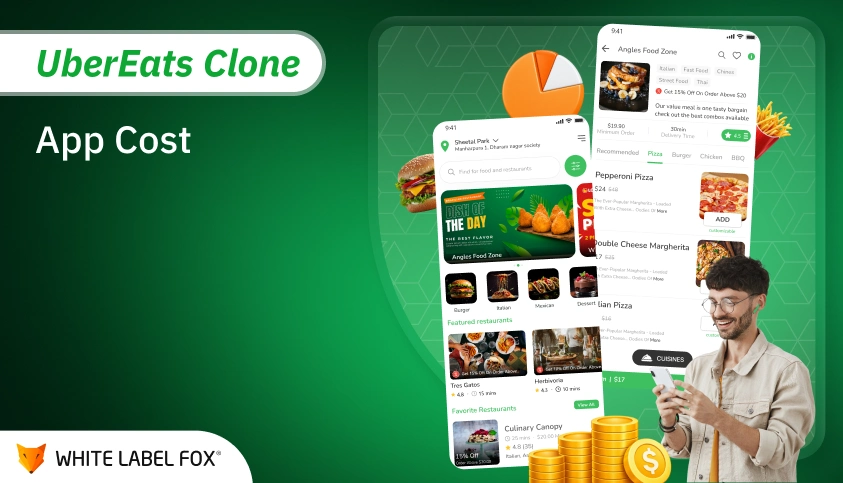
Restaurant aggregators, cloud kitchen networks, and regional food platforms use clones to launch delivery infrastructure without building the logistics stack from scratch.
Multi-service super apps - Gojek clone
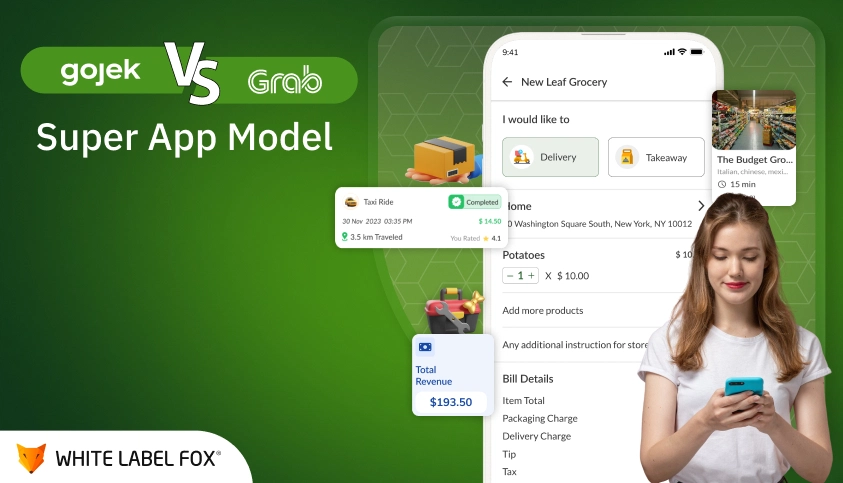
Entrepreneurs building "everything apps" for emerging markets - combining rides, food, groceries, and home services in a single platform - use Gojek-style frameworks as the starting point.
Home services - TaskRabbit / Urban Company clone
On-demand home repair, cleaning, and professional service platforms are built on clone frameworks that handle booking, contractor management, and payments.
E-commerce and grocery delivery
D2C brands and grocery chains launching hyperlocal delivery use Amazon or Instacart-style clones to compete regionally without the overhead of custom platform development.
Healthcare and telemedicine
Clinics and health startups use Practo or Zocdoc-style clones to build appointment booking, teleconsultation, and health record management platforms at a fraction of the cost.
Custom App vs Clone App: Which Is Right for You?
This is the question most businesses get wrong - not because the answer is unclear, but because they ask it too late. The decision between custom app development and clone app development should happen at the strategy stage, not after a vendor has already been selected.
| Criteria | Clone App | Custom App |
|---|---|---|
| Time to market | 4–8 weeks | 6–18 months |
| Development cost | 40–70% lower | Full build cost |
| Feature flexibility | Moderate (within framework) | Complete control |
| Technical risk | Lower - model is proven | Higher - architecture unproven |
| Best for | Startups, market entry, MVPs | Complex proprietary logic |
| Brand differentiation | Requires extra design effort | Fully unique |
| Scalability | Built-in (quality vendors) | Fully configurable |
For most startups validating a market and most enterprise teams launching a secondary digital product, clone app development wins on almost every practical dimension. Custom app development makes sense when the core value proposition of the business depends on proprietary technology that simply doesn't exist in any form yet.
App Cloning for Startups and Enterprise: Two Different Playbooks
App cloning for startups
For startups, the clone approach is essentially MVP app development for startups executed intelligently. Instead of spending six months building infrastructure, a startup can launch in weeks, collect real user data, and use that data to decide where to invest in differentiation. The capital saved on the initial build goes toward marketing, operations, and user acquisition - the areas that actually determine early-stage survival.
What startups need to get right is vendor selection and source code ownership. A clone built on a platform you don't fully own creates dependency that becomes a liability at Series A when investors look at the tech stack.
Clone app development for enterprise
Enterprise deployments use clone app development differently. The typical scenario is a large organization launching a new business unit, entering a new geography, or white-labeling a digital product for their customers. Here, clone app development for enterprise is about speed and operational efficiency, not budget constraint.
An enterprise deploying a logistics super-app for a new market does not have 12 months to build from scratch. A battle-tested clone framework, properly customized and integrated with the enterprise's existing systems (ERP, CRM, payment infrastructure), collapses that timeline to 6–10 weeks. The ROI is straightforward.
Clone App Development Cost Breakdown
One of the most common questions businesses ask is what clone app development costs relative to building from scratch. The honest answer: it depends on the complexity of the reference app and the degree of customization required. Here is a realistic tier breakdown:
| Type | Estimated Budget Cost | Description |
|---|---|---|
| Basic Clone | $5K – $15K | Single-service app, standard features, minimal customization. Good for MVP market testing. |
| Mid-Tier Clone | $15K – $40K | Multi-feature platform, custom UI, payment integrations, admin panel. Most B2B deployments fall here. |
| Enterprise Clone | $40K – $100K+ | Super-app complexity, multi-city deployment, custom AI/ML modules, enterprise system integration. |
Compare this to custom app development costs for equivalent complexity, which typically run 2–4x these figures. The savings achieved through app development cost reduction with a clone approach are real - but only materialize when the vendor delivers clean, well-documented code that your team can actually work with post-handover.
Is Clone App Development Legal?
Short answer: Yes - when done correctly.
Clone app development is completely legal as long as the clone replicates the concept, not the proprietary code, patented technology, or trademarked brand assets of the original application.
Business models, workflows, and product categories cannot be copyrighted. The idea of "ride-hailing," "food delivery on-demand," or "multi-service marketplace" is not owned by any single company. What is protected is the original source code, specific UI elements with registered design patents, trademarked names and logos, and proprietary algorithms.
A legitimately built clone app uses independently written code, generic map and payment APIs, original branding, and a feature set that mirrors - but does not reproduce - the original. The legal gray areas arise when vendors cut corners by lifting UI assets, reverse-engineering proprietary APIs, or cloning specific patented UX interactions.
This is exactly why the vendor you choose matters. Any serious development firm building clone apps will show you their original codebase, clarify their licensing for any third-party components, and provide an NDA that protects both parties. If a vendor cannot do this, that is a significant legal and operational risk before a single line of code is written.
Why Businesses Choose a Ready-Made App Solution
The term "ready-made app solution for business" often gets dismissed by purists who argue that everything must be custom to be serious. The market disagrees. The most active segment of digital product launches globally right now is on-demand services in emerging markets - and the vast majority of them are built on clone frameworks, not from scratch.
A ready-made app solution does not mean a low-quality solution. It means a solution that starts from a validated architecture and gets optimized for your specific market, rather than starting from theory. For businesses under pressure to launch, prove traction, and then scale - that sequence is strategically sound.
Conclusion
Clone app development has become one of the fastest and most cost-effective ways to launch digital platforms in today’s competitive market.
Whether you are a startup validating an idea or an enterprise expanding operations, clone apps provide:
- Faster deployment
- Lower investment risk
- Proven workflows
- Scalable architecture
- Faster ROI potential
However, businesses should also evaluate:
- Legal compliance
- Security standards
- Customization flexibility
- Long-term scalability
When executed properly, clone app development can help businesses launch market-ready solutions quickly while reducing traditional software development challenges.
Frequently Ask Questions

Viral Kacha - CEO & Sales Head
Author
With years of expertise in the on-demand app industry, Viral Kacha leads White Label Fox with a vision to empower startups and enterprises with top-tier, ready-made app solutions. His strategic approach, strong leadership, and deep market understanding drive business growth, innovation, and client success. He is dedicated to helping businesses scale efficiently with cutting-edge technology.