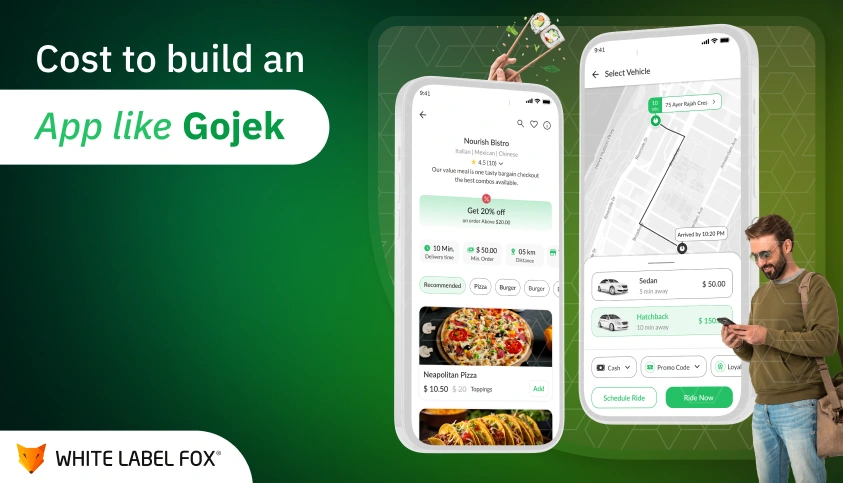
Super apps continue to dominate the global digital economy, and Gojek remains the benchmark for on-demand, multi-service ecosystems. As more entrepreneurs, startups, and enterprises shift toward diversified mobile platforms, the demand to build Gojek-like multi-service apps has increased dramatically.
But here’s the real question decision-makers ask first:
How much does it cost to develop an app like Gojek in 2026?
This guide provides a complete, research-backed breakdown of Gojek clone app cost, multi-service app development cost, feature pricing, timelines, and cost-saving approaches. Whether you're a startup founder validating an MVP or an enterprise planning an expansion, this article will help you build a realistic budget and roadmap.
What Is a Gojek-Like Super App?
Before diving into cost, it’s important to understand what makes a Gojek-style platform different from a typical on-demand app.
A Gojek-like super app integrates multiple services into one ecosystem, commonly including:
- Ride-hailing
- Food delivery
- Courier services
- Grocery and marketplace delivery
- Home and handyman services
- Payments and wallet
- Merchant onboarding
- Driver/provider management
- Real-time tracking
- Promotions, loyalty programs, and analytics
Unlike standalone apps, multi-service apps require complex architecture, high scalability, and multiple user-facing and back-office modules. This is the primary reason cost varies widely.
Why Are Multi-Service Super Apps Booming in 2026?
Several market factors influence the rise of super apps:
1. Customers want convenience in one place
Instead of downloading 10 apps for 10 tasks, users prefer a unified app with seamless switching between services.
2. Businesses want diversified revenue streams
Ride-hailing may be seasonal. Food delivery can have slim margins. A multi-service ecosystem allows companies to stabilize revenue.
3. Investors prefer scalable, multi-vertical digital businesses
Super apps can expand geographically and vertically without rebuilding new platforms each time.
4. AI and automation enable better operational efficiency
Modern super apps reduce manual dispatching, cut down cancellations, and streamline logistics with intelligent algorithms.
5. Faster go-to-market via ready-made solutions
Companies like White Label Fox offer ready-made Gojek clone apps like Fox-Jek, enabling entrepreneurs to launch quickly and cost-effectively.
What Does a Multi-Service App Include?
When estimating Gojek clone app cost, understanding “modules” is essential. Each module is a functional component and contributes to the final cost.
Below is the common module structure:
1. User App (Customers)
- Service selection
Customers can easily browse and choose from multiple on-demand services within a single app. The interface is intuitive, allowing users to switch between categories like ride-hailing, food delivery, courier, and home services effortlessly.
- Booking/order placement
Users can book rides or place orders in just a few taps with a streamlined, user-friendly flow. The system automatically calculates pricing, estimated time, and available providers to ensure a smooth checkout experience.
- Real-time tracking
Customers can track their driver, delivery partner, or service provider in real time on an interactive map. Accurate ETAs and live movement updates improve transparency and reduce uncertainty during the service journey.
- Secure payments and wallet
The app supports multiple payment options, including cards, wallet balance, and local gateways. Users can top up their wallet, view transactions, and enjoy fast, secure checkout with encrypted payment processing.
- Order history
Customers can review past bookings, invoices, and transaction details anytime. This centralized history helps users quickly reorder previous services and keep records for personal or business use.
- Ratings & reviews
After each service, users can rate providers and share feedback. This ensures service quality, builds trust, and helps the platform maintain a reliable ecosystem of drivers, merchants, and service professionals.
- Multi-language support
The app offers seamless multi-language support to cater to diverse user bases across different regions. Each customer can choose their preferred language, ensuring a personalized and accessible experience.
2. Provider/Driver App
- Task acceptance and rejection
Providers can instantly view incoming job requests with full details such as distance, fare, and service type. They can accept or reject tasks based on availability, ensuring efficient workflow and higher service accuracy.
- Navigation and route optimization
Built-in GPS navigation guides providers with the fastest, most efficient route for each task. Real-time traffic data and optimized routing help reduce delays, fuel consumption, and cancellations.
- Earnings summary
Drivers and service providers can track daily, weekly, and monthly earnings directly within the app. Transparent payout details, incentives, and commission breakdowns help providers manage their income better.
- Availability toggles
With a simple toggle, providers can switch between online and offline modes. This gives them full flexibility to work on their schedule while ensuring they only receive tasks when they are ready.
- KYC verification
The app includes a secure and streamlined KYC verification module. Providers can upload ID documents, licenses, and permits for approval, ensuring safety, compliance, and trust throughout the platform.
- Performance metrics
Providers can monitor key performance indicators such as acceptance rate, completion rate, customer ratings, and overall service quality. These insights help improve performance and unlock additional earnings opportunities.
Merchant App or Store Dashboard
- Menu/catalog management
Merchants can easily add, update, and organize their products or services through an intuitive catalog interface. This ensures customers always see accurate listings, prices, and item details.
- Order management
The dashboard enables merchants to view, accept, and process incoming orders in real time. Streamlined workflows help reduce preparation delays and improve order accuracy for customers.
- Stock and availability updates
Merchants can manage inventory levels and mark items as in-stock or out-of-stock instantly. This prevents order cancellations, enhances customer experience, and maintains operational transparency.
- Offer and discount settings
Store owners can create, customize, and manage promotional offers directly from the dashboard. This gives merchants greater control over marketing campaigns and helps boost sales and customer engagement.
Admin Panel (Super Admin)
- User, provider, and merchant management
The admin panel allows complete control over customers, drivers, and merchants, including onboarding, verification, status updates, and account management. This ensures a secure, organized, and well-regulated ecosystem across all services.
- Finance and settlements
Admins can track transactions, commissions, payouts, and revenue flows in real time. Automated settlement cycles and transparent financial reporting help maintain smooth operations and accurate bookkeeping for all stakeholders.
- Service configuration
The platform enables admins to activate, deactivate, or customize services based on business needs. Pricing rules, service areas, and operational logic can be configured easily without technical intervention.
- Promo and loyalty management
Admins can create discount codes, cashback offers, referral programs, and loyalty rewards to increase user retention. Centralized control ensures consistent and effective marketing campaigns across all service categories.
- Reporting dashboards
Visual dashboards provide insights into orders, revenue, user activity, provider performance, and operational KPIs. Real-time analytics support data-driven decision-making and help businesses optimize growth strategies.
5. Dispatcher Panel
- Real-time order assignment
The dispatcher panel provides instant visibility into all incoming service requests and assigns them to the nearest available providers. This ensures faster response times, reduced cancellations, and improved operational efficiency.
- Manual dispatch
Operators can manually assign or reassign tasks during peak hours, system exceptions, or high-priority situations. This gives businesses complete control over order allocation and helps maintain service quality.
- Fleet monitoring
The dashboard allows dispatch teams to track all drivers, delivery partners, and service providers in real time. Fleet monitoring ensures smooth operations, better route management, and quick issue resolution across service zones.
- SLA management
The system displays service-level metrics such as delivery timelines, provider response times, and operational delays. This helps businesses maintain SLA compliance, improve customer satisfaction, and optimize internal workflows.
6. Wallet and Payment Module
- Multi-currency support
The platform supports multiple currencies, enabling seamless payments for users across different regions. This flexibility makes the app globally scalable and convenient for international audiences.
- Wallet-to-wallet transfers
Users can securely transfer funds between in-app wallets, enabling quick payments and smooth peer-to-peer transactions. This feature enhances user engagement and keeps financial activity within the platform.
- Top-up and refund flows
Customers can easily add money to their wallet using cards, bank transfers, or payment gateways. Automated refund flows ensure quick reversals to the wallet, improving user satisfaction and reducing support overhead.
- Transaction history
Every payment, top-up, and refund is logged with clear details in the user’s transaction history. This provides full transparency, simplifies financial tracking, and builds trust with users.
7. Pricing and Surge Engine
- Zone-based pricing
The platform automatically applies different pricing rules based on predefined geographic zones. This helps businesses manage demand, distance, and operational costs more effectively across various service areas.
- Surge during peak hours
The system increases pricing intelligently during high-demand periods such as rush hours, festivals, or weather disruptions. Surge pricing ensures better provider availability and maintains service reliability when demand spikes.
- Automated pricing logic
Dynamic algorithms calculate fares instantly based on distance, time, traffic conditions, and demand levels. Automated pricing reduces manual intervention, improves accuracy, and keeps pricing consistent across all services.
8. Routing and Map Module
- Real-time ETA computation
The system calculates accurate estimated arrival and delivery times using live traffic data, provider availability, and distance. This ensures customers receive precise timing updates throughout their service journey.
- Dynamic routing
The module automatically identifies the fastest and most efficient route for drivers and delivery partners. It continuously adapts to traffic changes, roadblocks, and delays to maintain optimal service speed and reliability.
- Distance-based cost calculation
Trip and delivery costs are calculated instantly based on real-time distance measurements. This ensures fair, transparent pricing for both customers and providers while reducing manual errors and disputes.
Each module increases the complexity, timeline, and development cost — which is why multi-service apps are significantly more expensive than single-service apps.
What Influences Gojek Clone App Cost in 2026?
Costs vary based on several business and technical factors.
1. Number of Services You Want to Launch
More services = more development effort.
Launching only ride-hailing + courier = lower cost
Launching 15+ services = significantly higher cost
2. Custom Development vs Ready-Made Clone
Ready-made clones cost significantly less because:
- All modules are pre-built
- Workflows are tested
- Development time is reduced
- Fewer engineering hours are needed
Custom builds can cost 5–10 times more than ready-made solutions.
3. Real-Time Features and Scalability
Real-time tracking, multi-city expansion, and high concurrency require:
- Strong backend architecture
- Advanced DevOps pipelines
- Higher cloud infrastructure usage
4. Integrations
Complex integrations like:
- Payment gateways
- SMS/email providers
- Mapping APIs
- KYC verification
- Fraud detection
- Third-party delivery networks
These increase the total cost.
5. Compliance and Security
Fintech and wallet modules require:
- PCI-DSS compliance
- AML verification
- Secure encryption
- Audits and reporting
6. Technology Stack Decision
Native development (Swift, Kotlin) costs more than cross-platform (Flutter, React Native) but offers better performance for real-time apps.
7. Location of the Development Team
Hourly developer rates vary widely worldwide. Ready-made solutions bypass this issue entirely.
Build Your Super App With Experts
Work with a team that has delivered 7+ years of on-demand success globally.
Gojek Clone App Cost in 2026: Industry Price Bands
Below is the 2026 industry-standard cost breakdown:
1. Basic White-Label Gojek Clone (Ready-Made MVP)
Cost Range: $10,000 – $45,000
Best for:
- Early-stage entrepreneurs
- Businesses testing a single city
- Companies needing fast MVP rollout
Includes:
- User app + provider app
- Admin panel
- Dispatcher panel
- Basic wallet
- Default UI, colors, and branding
- Limited services (2–6 services)
2. Mid-Level Multi-Service App (Customized + Scalable)
Cost Range: $45,000 – $180,000
Best for:
- Startups expanding to multiple locations
- Companies needing uniqueness in design and user experience
- Platforms with moderate traffic
Includes:
- Custom branding
- Multiple verticals (6–12 services)
- On-demand + marketplace services
- Advanced wallet
- Loyalty programs
- Multi-language & multi-region support
- Enhanced analytics
3. Enterprise-Grade Super App (Fully Custom + Fintech + AI)
Cost Range: $180,000 – $400,000+
Best for:
- Large enterprises
- Banks, fintechs, telecom companies
- Regulated markets
- Multi-country deployments
Includes:
- Advanced AI matching engine
- Demand forecasting
- Hyperlocal dispatch optimization
- Complex multi-wallet structures
- Compliance & audit layers
- Fully customized user journey
- High-availability architecture
Cost Breakdown by Component
To help build a realistic budget, here’s a percentage-based cost allocation for a typical multi-service app:
- Product Planning & Discovery: 5–10%
- UI/UX Design: 8–12%
- Frontend Development: 20–30%
- Backend & APIs: 25–35%
- Integrations: 5–10%
- Testing & QA: 6–10%
- DevOps & Cloud Setup: 5–10%
- Security & Compliance: 3–8%
- Post-launch Support: 10–20% annually
These percentages help businesses structure realistic budgets internally.
Timeline to Develop an App Like Gojek in 2026
Timelines vary depending on development approach.
1. Ready-Made Gojek Clone (Fox-Jek)
Launch in just 5 working days after white-labeling.
Best for founders who value speed and cost-efficiency.
2. MVP with Moderate Customization
3 – 6 months
Includes basic services, branded UI, and essential workflows.
3. Fully Custom Multi-Service Platform
6 – 12+ months
Highly dependent on integrations, geography, and compliance.
4. Enterprise Build (Fintech + AI)
9 – 18 months
Requires extensive backend architecture and security layers.
Advanced Features That Increase Cost
Modern super apps in 2026 require more than basic features. Advanced functionalities can significantly boost retention and operational efficiency.
1. AI-Powered Smart Dispatch
Matches drivers and orders intelligently based on:
- Distance
- Traffic
- Provider availability
- Real-time demand
Reduces cancellations and improves delivery times.
2. Predictive Demand Forecasting
This feature uses historical data, user behavior patterns, and real-time trends to predict future demand spikes across different service zones. By anticipating upcoming surges, businesses can allocate drivers and resources more efficiently, reduce reliance on surge pricing, and maintain consistent service availability.
3. Real-Time Navigation & Route Optimization
The system continuously analyzes traffic conditions, road closures, and provider locations to generate the fastest possible route for every task. This not only speeds up deliveries and ride completions but also minimizes fuel usage, improves provider productivity, and elevates the overall customer experience.
4. Multi-Wallet & Payment Flexibility
Users expect:
- Wallet balance
- Credit/debit cards
- Bank transfers
- Local payment gateways
- Currency conversion
Fintech layers increase development cost due to compliance requirements.
5. Multi-Language & Multi-Region Setup
The platform supports multiple languages, regional formats, and localized service configurations to cater to diverse global markets. This flexibility allows businesses to easily expand into new countries or cities while delivering a familiar, culturally aligned user experience for every audience.
6. Loyalty Programs & Rewards Automation
Automated loyalty modules help businesses boost repeat usage by offering points, cashback, referral bonuses, and personalized rewards. These programs strengthen customer engagement, increase lifetime value, and encourage users to choose your platform over competitors consistently.
Build vs Buy: Which Option Saves You More Money?
Developing a fully custom super app requires significant capital, time, and operational investment. Buying a ready-made Gojek clone reduces both risk and cost.
Choose Ready-Made (Fox-Jek) When:
- You want to launch fast
- You want a proven operational workflow
- You want the lowest development cost
- You’re testing an early-stage market
- You want to scale gradually
Choose Custom Development When:
- You require unique business logic
- You’re operating in a regulated vertical (fintech, mobility)
- You need specialized integrations
- You have long-term enterprise budgets
For 80% of entrepreneurs and startups, ready-made solutions offer better ROI and faster growth.
Why White Label Fox Is the Best Choice for Gojek Clone Development
White Label Fox offers Fox-Jek, a ready-made Gojek clone with complete modules and a fast go-to-market advantage.
Key Advantages:
1. Go Live in Just 5 Working Days
No other development model offers such a fast launch timeline.
2. Complete Multi-Service Ecosystem
Includes:
- User apps
- Provider apps
- Merchant dashboards
- Admin panel
- Dispatcher panel
- Wallet
- Promo engine
- Reports and analytics
3. Scalable Architecture
Built to handle multi-city and multi-region traffic.
4. Custom Branding & White-Labeling
Your logo, your colors, your identity.
5. Cost-Effective Pricing
A fraction of full custom development.
6. Industry Experience
7+ years building on-demand and multi-service apps globally.
How to Estimate Your Budget Accurately
Use this decision framework to plan your investment:
1. Define core services for launch.
Avoid launching all 20+ services on day one.
2. Identify required vs optional features.
Wallet, loyalty, and AI can be added later.
3. Choose ready-made or custom.
This directly determines cost and timeline.
4. Set geographic scope.
Multi-country apps require multi-language and taxation logic.
5. Identify required integrations.
Payments, KYC, logistics APIs, ERP systems.
6. Add a 20–30% buffer.
Useful for unpredictable integrations or scaling needs.
Conclusion: So, How Much Does a Gojek-Like App Cost in 2026?
The cost to develop an app like Gojek in 2026 ranges widely based on approach:
- Ready-made Gojek clone: $10,000 – $45,000
- Mid-level customized build: $45,000 – $180,000
- Enterprise-grade custom solution: $180,000 – $400,000+
If your goal is to launch fast, test the market, and reduce financial risk, White Label Fox’s Fox-Jek is the most efficient and scalable option. You get a complete multi-service platform, branded for your business, and deployed in just 5 working days.
Frequently Asked Questions

Viral Kacha – CEO & Sales Head
Author
With years of expertise in the on-demand app industry, Viral Kacha leads White Label Fox with a vision to empower startups and enterprises with top-tier, ready-made app solutions. His strategic approach, strong leadership, and deep market understanding drive business growth, innovation, and client success. He is dedicated to helping businesses scale efficiently with cutting-edge technology.